The Benefits of Lonely Travel on a Friendly Planet

I’ve had some peculiar moments in Japan (as you have no doubt noticed already) and they have almost always come from the kindness of strangers. Now I’ve never really addressed why they are quite so kind before, but indeed there is a simple reason for it; more often than not, I travel alone.

I noticed as far back as on my trip around America with a good friend of mine, that a certain kind of person was simply more likely to attempt to engage you in conversation if you were by yourself. On some level you are simply more approachable. Also, the person about to randomly introduce his or herself might simply be more comfortable revealing their inner eccentric when in the presence of fewer people. Less potential embarrassment all round.

In Portland, my friend’s trip to the bathroom left me alone for the few minutes in which I struck up a conversation with the bartender as to why the fine brew I was currently quaffing was not available on Blighty’s fair shores (the answer is that production on the scale of Budweiser most often inevitably leads to an inferior product, therefore they were happy in Portland), the next thing I know the guy next to me was asking whether I fancied a tour of the very brewery I was stood in. Informing him that I’d have loved to, but alas, the tour closed two hours ago he quickly handed me his business card and replied, “no problem I’m a brewer here, let’s go.”

The friendly brewer then proceeded to lead my friend and I through every stage of the brewing process. Embarrassingly, I was so pleased with this I hugged the tiny brewer while we were stood in the hops fridge. As we reached the end of tour my friend and I wondered, how could this get any better?

“So here’s the beer lab.”

….brain explodes…

“and here’s your free six pack of unlabelled IPA.”

…oh dear Christ almighty…

So you see, I have much faith in the kindness of strangers, at least when said strangers have the opportunity to introduce themselves.

Japan certainly hasn’t let me down in this respect.

On my second trip to Shizuoka City to see a friend of mine, I found myself in need of a place to kill a few hours time and more importantly to get some grub in me. Not remembering the city all that well from my previous visit I attempted to wander in the direction of a hamburg restaurant I’d visited last time. Eventually, I tracked it down and found myself sat in a fairly empty slice of Germany, hamburg and spaghetti parked in front of me (some food combinations in Japan remain thoroughly beyond me). I was about half way through my meal when the only other customer, an elderly Japanese man started to talk at me. I say talk at me because I barely understood a single word of Japanese at the time, essentially any question asked of me that didn’t precisely match my text book was lost on me. But we persisted, each making efforts to bridge the gap, me with scraps of Japanese from my notebook, him through sheer bloody persistence.

One question he asked was fairly simple, ‘do you like cake?’ I nodded. The next thing I know a slice of cake appears in front of me, courtesy of the kind old man. I thanked him once and then again as he was leaving, at which point he asked me, ‘Do you like tea?’ Once again I answered in the affirmative, not expecting another slice of generosity. I hadn’t realized at this point just how prepared Japanese folk always are for gift giving. Sure enough, he reached into his backpack and pulled out a brick of green tea, handed it to me, smiled and was on his merry way.

It’s good tea too.


Ode to a Kotatsu: How to love the Japanese Winter

Nagano is cold in winter. Ok that’s not strictly true. Nagano is in fact, absolutely, bloody, freezing in winter, which perhaps explains the presence of a Winter Olympics here. It’s not Hokkaido but frankly it’s still pretty damn cold. Why is this an issue? Well, I live in Japan, possibly the only economically advanced nation in the world utterly bereft of insulation, double-glazing or central heating of any kind. So why do I not care about this? Because the Japanese have over the centuries come up with many interesting approaches to keeping warm on those crisp, cold winter nights.

The masterpiece of all this winter combating wonder is of course the kotatsu. In the grand scheme of Japanese heating gadgetry this is the last step. So I’ll come back to it in a moment.

First up, because the Japanese are usually very practical people indeed is warm clothes. Ok, I understand you were hoping for something more technologically advanced but as my erstwhile Swedish housemate once told me, he wasn’t a wuss for wearing thermal underwear during the British winter, rather he had a healthy respect for the cold. A respect, which we in England, he noted, lack to a quite insane degree. Any brief thought I may have had to defend my land was quickly dismissed by the unwelcome mental image of the average overweight Newcastle Utd fan on a Saturday afternoon in January; shirtless, rolls of fat cascading down over ageing denim and endless tattoos declaring an undying allegiance to the Geordie army whose main rival one might surmise to be the cold itself.

But back to Japan, with its citizens quite adamant about its clear and distinct four seasons (to the extent that my students always look rather smug when I explain the English seasons as one week spring, two weeks summer, a damp squib autumn and a never ending wet and windy winter), there is a quite dramatic shift in seasonal clothing as summer clothes get packed away and the autumn and winter wear is brought back from that nook in the bottom of the cupboard.

This dramatic a shift is to be expected really when all Japanese folk struggle with the fact that temperatures of twenty-two degrees and higher elicit a yelp of, “atsui/hot!” While twenty degrees and below elicits an immediate whimper from behind a scarf of, “samui/cold!” The magic temperature they all seek being a perfect twenty-one degrees, at which point they all get remarkably quiet, perhaps reveling in this moment of pure natural bliss while I interrupt their reverie by nervously muttering, “atatakai/warm? No…just me? OK… ”

Next comes all manner of electric blankets and under carpet/bed sheet heaters.  Each designed to keep you warm wherever you choose to plant yourself for the duration of the day because frankly, you’re not going anywhere. This is coupled with great big space heaters, occasionally with a hot plate on top for keeping a kettle full of water always ready for the gallons of green tea you are likely to consume in the course of trying to warm your poor frozen extremities.

But while all these things are necessary for one to get a cozy night’s sleep, or not to freeze your big toe off upon initial contact with the floor in the morning, they all pale in comparison to the mighty kotatsu.

The kotatsu is truly wonderful thing in my mind. The first thing I bought in Japan that turned my one room studio apartment, bereft of most furniture beyond the absolute bare necessities on my arrival, into something resembling a real home. Albeit, a perennially messy and cluttered one.

A kotatsu is essentially a blanket or duvet placed atop a low level table frame with the table top itself placed on top, thus sandwiching the blanket/duvet between the table frame and tabletop. In addition to this modern kotatsus have an electric heater installed on the underside of the table frame to heat the space under the table. To put it in a more western context, remember on cold winter mornings how you would clamber out of bed and drag the whole bed cover with you, wrapped around you and dragging behind as you went downstairs to watch Saturday morning kids television, before cable and satellite television killed off the children’s variety show that is. Now add a table so that you never, ever need move from your cosy spot in front of the TV, and that’s a kotatsu.

It’s also a way to be very lazy indeed. Without noticing your kettle will strangely migrate in the night to find a new home atop the kotatsu, soon your legs will rebel at the thought of ever leaving their cozy new home and bed will become a distant memory as you begin to nap beneath your new abode, content in the knowledge that when you awake the kettle is already in reach.

This winter is going to be very lazy indeed.

Real Cuteness Means Hard Work

Bound at the ankle and being screamed at in a high pitch wail, my life in Japan had once again taken a turn into new realms of oddness.

Hold on, take a deep breath.

I don’t live in Tokyo and this story isn’t nearly as dirty as that opening line makes it sound. In truth the whole thing was pretty cute, because the high pitched wail was emanating from a group of fifty of my adorable kindergarten students screaming, “Gambatte Matto Sensei!” Which simply means, “go for it Teacher Matt!”

And my bound ankle? I was in a three-legged race with the other kindergarten teacher.

See? Now you feel bad for leaping to such filthy minded conclusions. There’s your mind launching headlong into to the seedier side of life and I was merely attempting to write a somewhat dramatic introduction to a day in my otherwise uninteresting life by dropping you into the middle of the action. That action being a typical Japanese sports day or undoukai as it is known here in Nippon.

Now just because the kids were adorable doesn’t mean this event was any less rigidly structured than the rest of Japanese society.

It’s always worth remembering that the Japanese don’t do anything by half. You work until you drop, whether in high school or as a suited salary man. Everything must be cute, even the animation on the TV at the Driving License centre imploring you to do up your seat belt or risk a violent, long jumper-esque death through a windshield. Sports clubs require daily dedication. You must maintain true Japanese traditions, shrines and temples dotting the countryside. You must embrace modernity, McDonald’s and KFC dotting the freeways. Spirituality is not hidden away, but a church will sit opposite a hostess bar. Gambling is banned but Pachinko is everywhere. Japan is a safe, relatively crime free country… oh look a Yakuza in the front row of the sumo.

So of course, the Kindergarten Undokai, or sports day doesn’t escape this. Teachers and the PTA had been at the school since around four a.m. Parents and family had begun to arrive at around six a.m. in order to drop their blanket on a prime spectator location. Me? I rolled in at ten thirty and sat with last year’s PTA who were the guests of honour. My job has some minor perks.

What followed would usually fill me with a certain amount of trepidation. I know full well how long Japanese educational events can last, the organization that goes into them and just how tired people look when it’s all done and dusted. Then there’s the speeches…oh lord.

But instead it went by in a flash. The parents of the students made me feel welcome. I chatted in broken Japanese with a member of last years PTA about how cute yet strange the whole day seemed to me and she did her best to explain what the upcoming races were and the rules involved. I attempted to eat as much of the sushi on offer at lunch with the teachers (I’m afraid I rather struggle with the level of Japanese vinegar in the sushi, which is frustrating since the amount seems to vary considerably through the year meaning sometimes I think it is delicious and other times my face turns into a contorted mess) while answering their questions to the best of my abilities. I even raced twice, one time in a centipede race with three of the dads and once in a three-legged race with one of the kindergarten teachers.

The strangest part of the whole day was also possibly the most impressive. The dance routines from the five and six years olds were incredible. Bright costumes, highly choreographed routines displaying an excess of cuteness to match the incredible precision of sixty five year olds dancing in perfect time.

That’s kind of Japan in a nutshell really, even their love of all things kawai or cute isn’t free of a good months hard work.

チーズ or Cheese: Technological Trouble in Japan

In Japan I have a peculiar relationship with technology, simply put, I just don’t get it.

Cameras are state of the art. Mobile phones are a generation or two ahead. The fax machine still prevails. Broadband Internet is around the fastest and cheapest around, yet take-up is lower than in the US and far lower than that of neighbouring South Korea. I can press a little red button in the Izakaya for instant service and my sushi can be delivered by tiny bullet train (it whisks specific orders directly to your table, as opposed to via the conveyor belt below from which anyone can pick up food). Vending machines greet me in a high-pitched yelp of digital politeness. Lifts in some government buildings appear to pre-date the buildings themselves. My sixty-year-old student can watch TV on his phone, but I don’t think he knows what Google is. When my high school kids tell me they were talking to their friend, they mean they were emailing them. Japanese people buy the best technology around… so long as it isn’t Korean, and then they do it again next year and the year after. The TV is always on, yet no one is ever watching it.

As I’ve noted before, the Japanese have a peculiar relationship with technology. Driven by a rapidly ageing yet economically driven society, consumer goods are constantly bought only to be dispensed with a year later for the shinier new model.

Japan seems to have an endless supply of engineers and a desire to have the best products in the world (look at Toyota’s misfortunate and excessively rapid expansion) yet, Apple’s attempts to get Macs into Japanese schools has been rebuffed with little thought. Technology is welcome in some spheres and clearly not in others.

At times, I find it difficult to cope with this contrast.

When I was younger, my relationship with technology was far more simply defined. My brother would convince me as to what now ancient games console I obviously wanted for Christmas. One so costly as to require the budgets from both our respective birthdays and Christmas days to be combined so that come Christmas morning we could open something that I had not known I had even wanted until a month earlier. Possibly as I hadn’t known of its existence until my brother made it abundantly aware that I too wanted it. Funny that…

While owning a games console, laptop and mobile has become an aspect of my life that I would find strange to do without now, other areas of technology have on occasion left me baffled. Particularly in Japan where I sometimes think that maybe, just maybe I’m too tall for it…

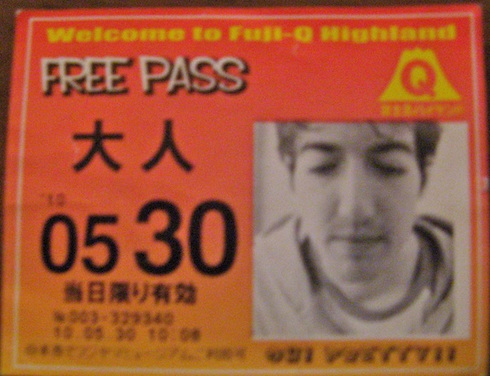
I was entering the gates of Fuji Q Highland, an amazing amusement park that sits just below Mount Fuji. I handed my ticket over and headed over to the machine where I would get my personalized ride pass. It was a metal box, akin to a photo booth without the curtain and seat. Instead of said seat there were two foot prints where one was supposed to stand. So there I placed myself, only to realize that the camera was about chest height on me. I crouched down a little to get my head level with the camera but nothing happened. Wondering if the damned thing was even working I leaned forward for a split second, the wrong split second as it happened.

チ-ズ!Cheese!

Pachinko: The Cost of Solitude

They can be found everywhere in Japan. In major cities and in the sleepy countryside alike, the sound of high pitched ringing and pinging flows out of automatic doors as they open to let some poor bespectacled salary man back into the harsh light of day, far from the neon buzz and cacophony of electronic noises of his temporary home and refuge, the Pachinko parlour.

What is Pachinko you may ask? It’s a question I’ve asked my students many times and, “a sort of pinball,” is the only answer I’ve ever received as they remain strangely non-committal in their answers. A way to lose money while being assaulted by flashing lights and random video sequences to build up suspense would have been my guess, but such is their popularity in Japan I’m inclined to believe I may be missing part of their appeal.

According to the Japan Times the game evolved from an American Pinball machine originally exported to Japan to be sold as a children’s toy. Over time the humble pinball machine became an adult’s game and something of a gambling phenomenon.

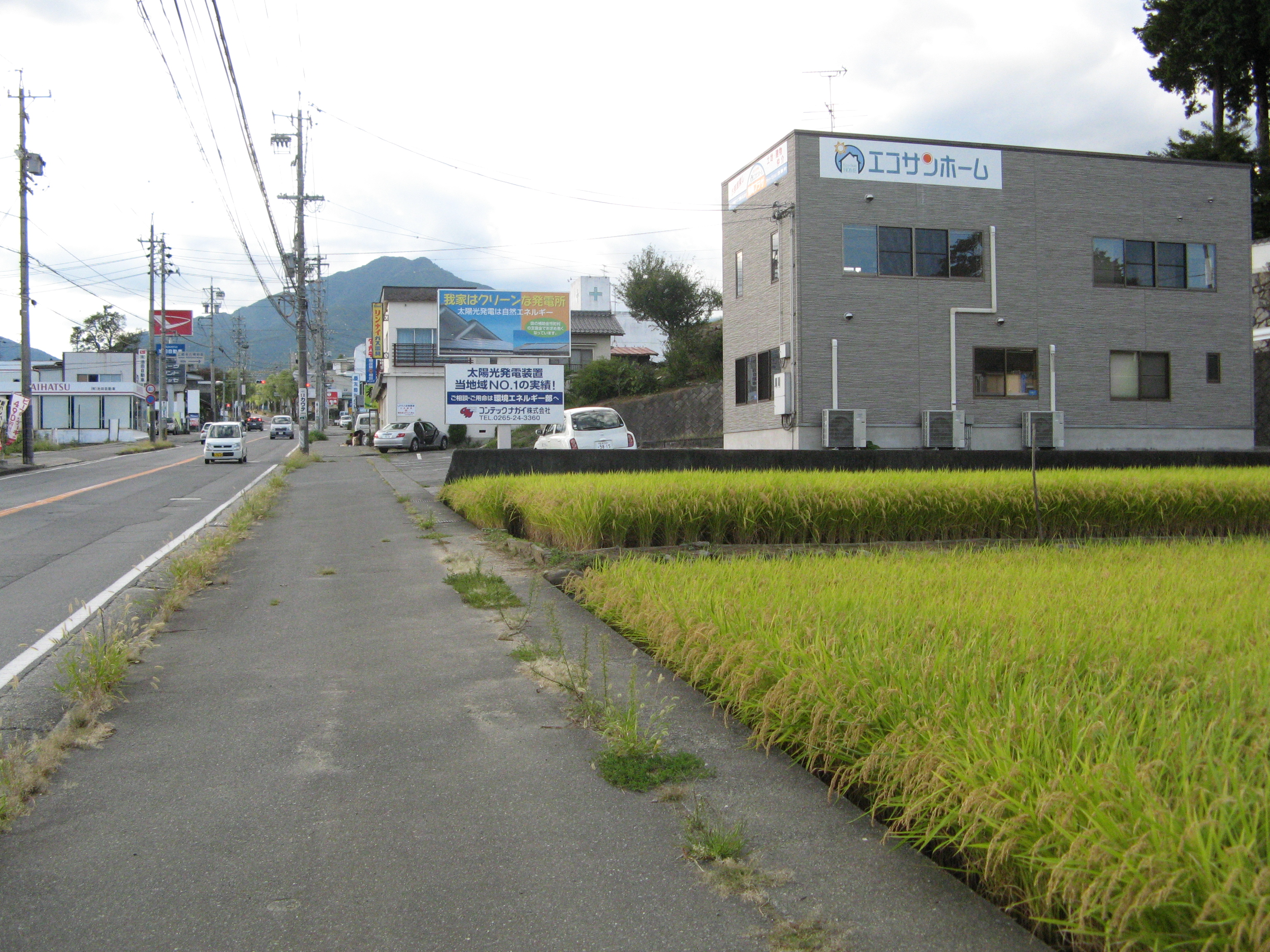
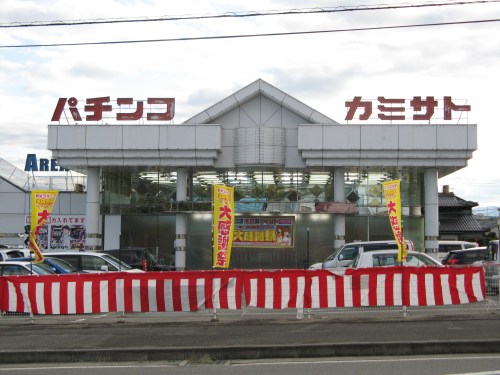
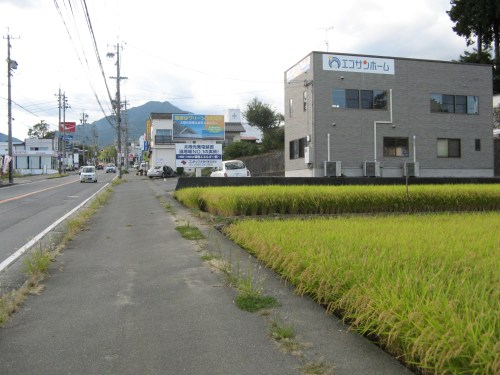
How much of a phenomenon? Well, two minutes down the road from my apartment, on an otherwise non-descript yet quiet (for just how quiet, see the below picture) road leading in one direction to the highway and in the other to the quiet city centre, sits a fairly typical Pachinko parlour. It has as many parking spaces as the local supermarket and unlike the supermarket they seem to be in demand every moment of the day. They can be found in every city and in my travels I find them to be almost everywhere where one can find a space to build one; in a form of architecture that can only be described as Buck Rodgers style modernism.
Their names are usually snippets of English, something that hints at victory and competition, for example ‘Champion’. Anime or Manga style art often play a role in the signage lending an air of fiction to the places. I suppose it adds to the feeling of a different world that casinos often try to create in order to keep gamblers at their tables through the night by making sure the environment remains the same no matter the time of day. It also on a far more obvious level taps into the general adoration of all things Manga.

Yet, while I can see the Pachinko machine’s roots in pinball, as it looks essentially like a vertical pinball machine with added things to twist and push and generally confuse and distract its players with, it has evolved into something all the more confusing and inherently Japanese in its design. In fact if I had to describe it to someone my best attempt would be Akihabara in a box. A neon cacophony dedicated to the art of switching off from the hustle and bustle of life itself.

The game itself is appallingly simple. You rent little pachinko balls (think pinballs) for around four yen a ball, so a thousand yen note will get you about 250 balls. The aim is simply to win more balls which allows you more opportunities to get them to drop into the central gate that then activates the slot machine element of the game that allows you to win yet larger prizes. To get a considerably more detailed overview of how the game works, check out the Wikipedia Pachinko page.

However, while they may be on almost every other street in Japan they are not necessarily all doing quite so well. Nationally Pachinko is actually worth more than Japan’s domestic auto industry and an individual parlour can easily make $25 million dollars a year. Yet, despite these huge figures, on my regular drive to lessons I pass two empty, creaking and dilapidated Pachinko relics. Thanks to their distinctive design no one appears to have any interest in reusing the buildings themselves. A friend of mine has even noticed one such Pachinko palour is currently filled with the product of this years rice harvest. A gambling den converted for use into a grain silo of sorts.

The house, clearly, always wins, unless as in the case of the latterly mentioned derelicts, the house is too big for the area it resides in. But the size and number of them in my otherwise sleepy little city suggests that these colossal gambling halls, are on the one hand incredibly popular and the other, very profitable indeed.

When my friend played the other day, in an attempt to fathom what the hell the appeal of these machines was he dropped a hundred yen in a low risk, low win machine that lasted as a game for all of fifty seconds. However, people will spend hours upon hours in these places and rarely beat the house and if they do only by a measly margin.

How much, is a moment of solitude costing the average Japanese person who indulges in Pachinko? According to The Japan Times in a 2007 article, “a YRI survey of about 2,000 respondents conducted between September and October in 2006 found that the average amount spent on pachinko was a whopping ¥28,124 per visit.” In pounds, for my English readers, that comes to a whopping, £214.67.

As David Plotz notes in his article on Pachinko in Japan (and it only exists in Japan) the all-pervasive, easy access and economically draining variety of gambling that it takes the form of (in contrast to the economic and tourist draw of places like Las Vegas) is seen by academics to be the worst kind of gambling in a society from an economic standpoint. What does that mean exactly? Well you’d happily fly to Las Vegas, see a show, eat some fine foods, drink some colourful cocktails and generally have a good time. Possibly even, without gambling a single penny, but no one is flying to Japan for Pachinko.Certainly not for the parlours in my city.

The strange thing is, technically, gambling is illegal in Japan. Yet, Pachinko operates in a grey area where it is generally ignored and loosely regulated. There is no moral distain for Pachinko as far as I can tell in my day-to-day life and so as noted in the fantastic piece on Pachinko on the New York Japan Society website by David Plotz, Pachinko is treated like many other vices in Japan, as a purely practical issue.

The nervous shuffling from my students when I from time to time ask them certain questions is usually pretty indicative of unspoken elements of Japanese society that they know to be logically harmful, perhaps even shameful but to which they turn a blind eye. That personally the appeal of Pachinko remains elusive to me is obvious, I come from a generation and a culture with other means of escape from the daily grind; indeed not being Japanese I don’t believe the daily need be a grind at all. Yet, that shuffling persists because while I cannot discern the comfort one receives from the abandonment of self in somewhere as noisy and crowded as a Pachinko Parlour (if only for that brief few hours a day to maintain one’s own sanity and separateness from the solid whole that is Japanese society), it is simple to discern something that the Japanese know too well already. That a practical response to something damaging, is nothing to be ashamed of, but if that solution includes the desire to pretend it doesn’t exist at all, to never discuss it in real detail then it will be left to fester all the worse.

When Japanese Kawaii! Culture goes a little too far…

Walking back from taking the pictures for this article, I passed by a stonemason’s that deals primarily in gravestones.  These kinds of places are scattered quite openly around Japan and are fairly easy to come by, indeed I pass by one with an enormous nine-foot tall figure outside in lieu of an actual sign when I drive to certain lessons.  I’ve always been rather impressed by the craftsmanship and obvious skill involved. In a country so full of flashes of neon it’s nice to come across something of the traditional and understated from time to time. Something respectful of its heritage, not gaudy when it should be gracious.

But then I saw something less funereal, more furry… he does look rather dapper though.

Accidental Adoption: Manners and Stray Families

Jetlagged, weary and still thinking a bit in Japanese having only been on English soil for all of an hour, I lumbered onto the tube, bags in hand and wishing I didn’t have to take the Circle line of all things. Immediately two enormous suitcases caught my eye. They had JAPAN in big letters plastered across them and sure enough on the seats surrounding these great hulking bags sat a rather sleepy, but mostly nervous looking Japanese family.

Half asleep myself, I spotted the only spare seat in the carriage that just happened to be next to this family. I wandered over, dodging other passengers, attempting not to jostle or knock anyone with my rucksack, and without thinking asked the nice family, “Is it ok?” and pointed at the seat.

Fine right? Nothing odd there, except, well… I asked in Japanese. In London. On the tube, where nobody speaks to strangers and certainly not in that stranger’s native tongue.

I got a nervous, “hai/yes” in response and so I slumped down into the seat. Of course that wouldn’t be the end of it though. I could see the family nervously glancing at one another, reflected in the opposite window, wondering whether to engage this utter stranger in conversation. This went on for a minute or two before I felt bad for getting them all in a kerfuffle and turned and asked them where they were going.

Pari, as the Japanese call Paris, was the destination. Followed by a variety of confused questions as to why an Englishman was speaking Japanese (however poorly).

After helping them successfully get off at the right stop, which conveniently also happened to be my stop, they quickly gathered the courage to ask me what they’d clearly wanted to ask me all along, “could I do them a favour?”

Here was their problem; they were staying with their daughter’s friend’s family in Paris. Their daughter’s friend speaks Japanese. However, they’d been unable to get in contact with her as they only had the home phone number. The family of said girl would in all likelihood pick up the home phone, the family that only spoke French and English.

Bugger.

I was immediately handed a mobile phone, already dialing. It rang and rang and I found myself thinking, “Why don’t you ever just not talk to strangers? Bloody plonker.” It rang a little more…

And nobody picked up.

Thank god.

We said our goodbyes, they thanked me for my efforts and waved me on my way as I went with a good friend to get my first taste of English ale for eleven months. Over that beer I began to wonder, how the hell had I managed to accidentally adopt a whole Japanese family?

Japanese politeness that’s how.

I should know better.