Category Archives: Living Abroad

The Ojigi’s Up

It was my third time home and I knew things would be different. The first time I came home Japan was still new and shiny, I hadn’t even begun to scratch the surface of the country, the language remained utterly mystifying beyond the simplest of exchanges and I had little idea that some two years later I’d be visiting home for the third time still with no end in sight to my time in Japan.

Coming home this time was different for a quite simple reason; I’ve passed what Malcolm Gladwell coined The Tipping Point when all the little things begin to coalesce and emerge as the beginnings of a new whole… on the London Underground of all places.

I’d made it through Heathrow airport in one piece and was at this point on the tube winging my way through London. As I went to alight at Oxford Circus to change to the Victoria line an older gentleman attempted to get on the train at the same instant. There was a moment of sidestepping in unison, left then right, a lean back and a shimmy forward before I thought to myself, hold on passengers get off first, and slipped past him with my mid-sized duffle bug.

As I put the bag down on the platform it occurred to my jetlagged brain that perhaps the older man had not in fact been letting me off first and had been thinking age before youth, or more likely in London, screw you mate I’m going first.

So, nervous that I may have offended the man I turned around as the doors were closing to give the man a slight nod to show my appreciation or apologies.

Except I didn’t nod.

The head moved forward yes, but my neck didn’t so much as creak. The pivot had come from my waist.

I’d bloody well ojigi-ed (bowed) to the miserable old bugger.

Ok it was only a slight ojigi certainly but it was noticeably not a nod.

Two and a half years ago I’d barely scratched the surface here; I knew that. What I didn’t know was that Japan had not only scratched my surface it had damn well got under my skin, buried itself in my subconscious to the point where muscle memory if left unchecked would leave me bowing to poor defenseless Brits across the land.

However, uncontrolled and hopefully largely unobserved ojigi-ing is not the only symptom.

I’ll get to them in the next post.

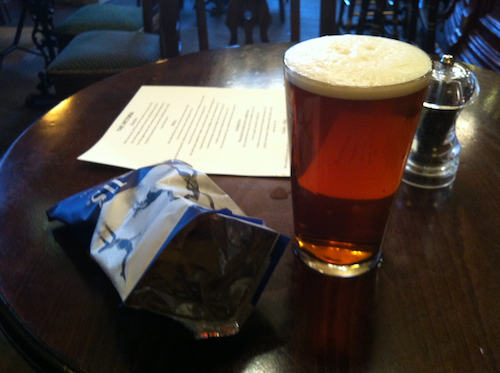
In the meantime though, I may have found a cure while I was at home at least.

Simple yet effective.

I wonder if they serve it on British Airways?

The cure to what ales thee.

Haneda Waiting

At this moment I’m at the airport.

Here since 10:00pm yesterday waiting for my 6:25am flight today. Experiencing first hand the joys of Haneda airport scheduling that doesn’t allow them to run international flights at the same time as Narita.

Don’t get me wrong, I quite like the 6am departure time, what I’m not so fond of is the fact that it necessitates the use of a hotel room nearby or in my cheapskate case, the use of a bench to park myself on as I vainly try to ward off sleep until I’ve boarded my plane in some foolish attempt at avoiding jet-lag.

At least there’s free wifi.

Sparkly trees in Haneda Airport

Because it’s an airport Christmas… they’re probably lit up all year round.

It’s about 1:00am now and I’ve set up shop on the 5th floor of the airport.

It’s quiet up here; the rows of people sleeping across three seat benches are sleeping surprisingly quietly or watching DVDs on their laptops. Mercifully no loud, guttural snoring echoing on polished floors.

I’m across the hall by the windows. Typing quietly, slowly. Not my usual mad scientist, jazz pianist approach to typing.

There is however one noise that pierces the air at every moment.

The escalator with a split personality.

The escalator with two voices.

The English voice is calm, American, authoritative but dulcet. At least to my western, currently sleep deprived/soon to be jetlagged, ears. I assume the voice, despite being computerized in some fashion, to have at some point belonged to a beautiful woman. It sounds like someone I’d listen to instinctively. It exudes a certain sense of control, it gently reminds you of the danger you know to be part and parcel of motorized steps.

The Japanese voice sounds younger but that doesn’t mean much. Most Japanese women are in possession of the ability to shoot up a couple octaves when on the phone or if they happen to work in the service industry. It doesn’t sound authoritative, it sounds worried, somewhat cloying. Like a child reminding you that you promised to take them to Disneyland this weekend.

I wonder whether Japanese hear the same thing as I do. I wonder if I’d even hear it were I in possession of more sleep or something stronger than a bottle of green tea.

Is the cure to cloying, coffee?

I think it might just be… if only because the café is about 50ft from the closest escalator.

Edo Restaurant in an Airport

Either an Edo era restaurant inside an airport… or the dojo from Street Fighter.

But this is always a risk you run in Japan. The technology talks, it beeps, it whirs and it chimes. It attempts to lull you into a true sense of security through a casual barrage of unadulterated, undiluted Disney voices (excusing Donald’s voice, presumably they use that in prison though for a sense of commanding cuteness).

I typed too soon.

The snoring has begun, the lights have been turned up to a daybreak kind of glare and music is beginning to chime louder across the whole place.

Time to escape for that coffee I think, before Donald’s voice comes across the tannoy to inform me that the check-in desk is now open.

American Joku

A student asked me the other day, as part of his speaking test, which country do I prefer, my own country or Japan?

If I’m honest I’d never thought to make them compete in such a way before. There’s such a difference between them that the idea of them duking it out makes me think of some kind of hybrid judo/boxing bout. Not a natural contest certainly.

Yorkshire countryside

Yorkshire countryside

What it comes down to though, beyond the general incompatibility of the contest is that I’m not entirely sure what it is Japan is supposed to be competing with.

I’ve moved around a lot in the last twelve years and it means I tend to get itchy feet, I’m ready to move on to the next place or the next challenge every three years or so. I guess I just don’t have that firm a sense of home, nothing concrete with which to pit Japan against in a duel for my affections.

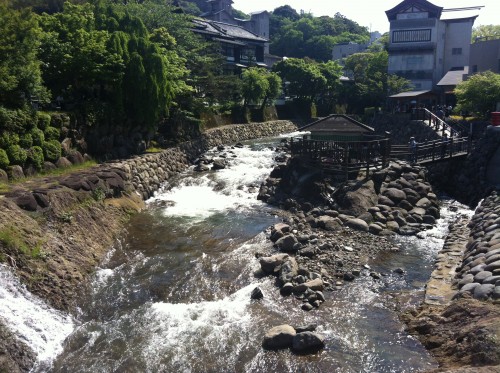
Shimizu Town, Izu Peninsula

Shimizu Town, Izu Peninsula

Yet, while they don’t compete for my affections per se, there are points where a certain friction can emerge. A point where something from my own background, a well-worn and engrained aspect of my culture that just doesn’t seem to fit naturally with where I live now.

Black humour, dark humour, whatever you want to call it.

It’s a stereotype; the unfailing polite image of a Japanese businessman, bowing and scraping, perhaps perpetually ruffled by the demands of his superior yet no matter how insane the entreaties remaining calm.

Until the day he utterly explodes in a spitting, red-faced ball of rage.

There are days where I wonder if this may happen to me one day. Not so much while I’m here in Japan but maybe one day, in a western country when I’m once again exposed to the endless stream of black humour that I have such a mixed relationship with now.

So what is my issue with it?

Well, simply put I think our definition is blurred and our funny bone myopic.

The last time I was back in the UK I bumped into a few tsunami jokes. I can only imagine that nine months earlier these jokes were quickly doing the rounds via text message and passed around in pubs and bars in greater numbers along with the adage that if you don’t laugh you’ll cry which is to say that we see this as essentially gallows humour.

There’s one problem though, for it to be gallows humour the person telling the joke needs to be the one in that terrible situation, not the one sipping his pint safe from all but liver disease and chronic un-funniness.

There were two cases in point even before last year’s Earthquake. The first was the Qi joke about the luckiest/unluckiest man alive Tsutomo Yamaguchi who had the horrible misfortune of being in both Hiroshima and Nagasaki when the bombs fell. Soon after that Top Gear managed to put its foot in its mouth once again by crudely stereotyping Mexicans only to receive an immediate complaint from the ambassador they claimed would be too busy dozing to actually catch the offending remarks; par for the course for a TV show that casually labeled lorry drivers as prostitute murderers.

There is one difference to be maintained though. Qi’s joke, to British people was funny. The focus of its humour was on the absurdity of the event, the contrast between Japanese railway efficiency and British rail’s ability to shut down if it’s the wrong kind of snow. The subject matter may have been insensitive, but the people making the jokes were simply doing their jobs and poking fun almost entirely at British absurdity.

In contrast Top Gear is taking the more schoolboy approach. The humour comes from the fact that they are deliberately being insensitive and rude albeit with a wink to knowing better…I hope.

Too much of our poor taste humour gets let by simply because we wrap it in supposed lack of poor intentions. Yet, good intentions, or in this case a lack of negative ones doesn’t change the nature of language and the way that all these jokes build up layer upon layer to the point where we’re laughing and utterly unaware that other people are still crying.

I know the people who tell these jokes by and large don’t mean any harm but I also know that if a joke was told on Japanese television about a tragedy that remained as firmly in the public conscious as Hiroshima and Nagasaki do here, for example Hillsborough, then black humour and making allowances for Japan’s comedy conventions would mean very little indeed to a large part of the British population.

The truth is though, I’m not that angry about all this. Mostly, I’m just disappointed that a nation that can produce internationally renowned comedy like Monty Python, Mr Bean, The Office etc. isn’t working harder to maintain those high standards.

I know that there is no spite in these jokes, that British people by and large simply enjoy bending and breaking the line between edgy and in poor taste, the fact of the matter is that the rest of the world simply doesn’t know us well enough to get the joke.

Disappointingly though, as my younger students have often shown, Japan isn’t actually that interested in getting to know us anyway. They already have their own way of dealing with Western humour. It’s very simple really, whatever the subject, no matter the nationality, if they don’t get the joke it can mean only one thing.

It’s an American Joku.

Maybe there isn’t so much friction after all.

Marshmallow Sensei: Award Winner?!

So, rather unexpectedly I got an email the other day from the kind folks at teacherport to inform me that I’d been shortlisted for an award and that the winners would be announced the following day.

Naturally I spent a certain amount of the next day checking in on the website to see if wee lil’ Marshmallow Sensei had managed to sneak over the finish line… long story short; thank you teacherport!

I was absolutely thrilled to receive the award and I’m glad you’ve enjoyed my rather infrequent posts. Hope I can do enough to be in the running again come next year!

Blog.Winner.2012

Driving in Japan: Does Cuteness Save Lives?

I had front row seats to the show. A whole two hours of what I assumed would be a thoroughly gruelingly attempt at straining my ears to follow a single word the instructor said and praying to any deity that’d have me for a follower that I wouldn’t be asked to speak in any way shape or form.

Evidently that was simply too much to ask. You see I’d found myself at the local driving license centre in the neighbouring city to mine (small mercy that it was actually that close at all) and as per protocol I had to endure a full two hours plus of administration, eye tests and a lecture on driving safety.

Fortunately my rather unhealthy addiction to anki, a bit of memorization software that is almost entirely responsible for my current level of Japanese, meant that I actually was able to follow the vast majority of what was going on in class.

Well, for twenty-minute intervals anyway. After twenty minutes of full speed Japanese, on a subject I’d never before discussed, it would be an understatement to say I drifted off somewhat.

I wasn’t fully conscious of where my mind wandered at all times (some of the locations may not be appropriate for publishing) but it at some point I’m sure it ambled towards the posters directly ahead of me in my front row seat.

Glossy, largely cartoon figures bidding me to be safe on the roads and one vaguely age appropriate poster that suggests not throwing away my driving license by drinking and driving.

Personally I’d rather they implore people not to drink and drive because they might kill the adorable little cartoon toddler in the poster next to the driving license drowning in a glass of remarkably carbonated beer.

Cuteness saves lives!

But, culturally I’m probably missing a trick here.

The reason I unfailing always buckle my seat belt, aside from the law and not wanting to die at 40mph as I go hurtling through a windshield, is because at a very young age I was suitably emotional scarred by an advert that informed me that if I don’t buckle my seat belt while sitting in the back seat I’ll probably survive… I’ll just have killed the person in the seat ahead of me.

As such, is it possible, that the emotional pull of Kawaii (cute) in Japan might be equally effective in altering the behavior of Japanese drivers?

Evidently not.

A recent editorial in the Japan Times points out that while the number of convictions has decreased as the laws have gotten stricter more still needs to be done to curb drink driving in Japan.

Yet, Japan has some of the strictest drink driving laws in the world, at least as far as what constitutes drink driving and statistically at least appears to have less of an issue with drink driving than many countries.

The thing is the stats are what bother me, because in the talk I received on the matter the focus was certainly not on lives lost, but the punishment and damage to the driver. The fines paid, the loss of your job because you can’t drive, your family leaving you because you can’t support them anymore. Little mention of the victims involved beyond the driver.

Therein lies the problem. When the focus is on the cost to the driver, how much do you think the police are actively enforcing these laws?

The driver first; unless you might run over a vaguely suicidal old person crossing the road that is.

Try not to run over old people with no sense of their own mortality.

Then there was the recreated footage of a traffic accident involving a drunk old man on a bicycle and a woman who clips him with the back of her car as she pulls into her driveway. The moral of the story? The woman should have continued to check where the cyclist was once he had passed her. While that is certainly a very good idea indeed there was no mention of avoiding drinking and cycling or the fact that that too is illegal in Japan.

Check out Surviving in Japan for a full breakdown on cycling law in Japan versus its odd reality. http://www.survivingnjapan.com/2011/09/about-cycling-and-biking-in-japan.html

But then again, this was all pretty fast and I’m sure I missed some chunks while my brain melted like an overheated computer chip as it attempted to translate at speed.

On the other hand, this is simply another reason why I found myself worried by the talk. Not because the instructor wasn’t earnest or that people weren’t paying attention, but because downstairs in the lobby where I filled out paperwork part of the form was handily translated into English; but not a word during the talk.

At one point during the talk all of the participants were asked to participate in a mock test. Asked if I could understand Japanese by the instructor I told him the truth, “Yes, I understand most of what you’re saying however, in this situation I don’t really know much of the driving vocabulary.”

He responded by trying to explain hai and iie to me (the Japanese for yes and no). Then when I assured him that yes I can read a hiragana, katakana and a fair bit of Kanji (the two scripts in Japanese and Chinese characters) and no I probably couldn’t keep up with the mock test he waved my comments away and carried on at full blast.

I didn’t have a chance in hell.

But that wasn’t important. I was there, I was participating and I had the appropriate paperwork.

What does it matter if I couldn’t follow every detail? I’m sure all the important information was relayed to me in cartoon form anyway. If that didn’t cover all the bases, well then, the awesome 80s soundtrack on the VHS video transferred to a swanky DVD will have most certainly conveyed everything I needed to know, right?

Car accident + music from The Terminator OST = Bad Driver.

Got it.

Drunk on Culture

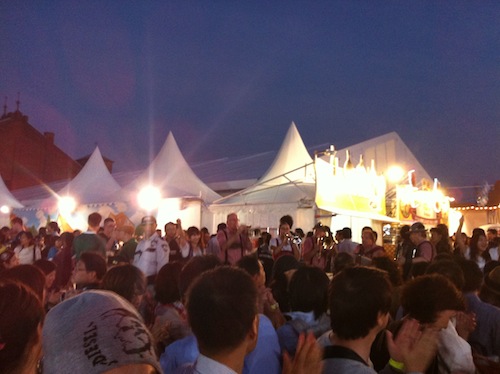
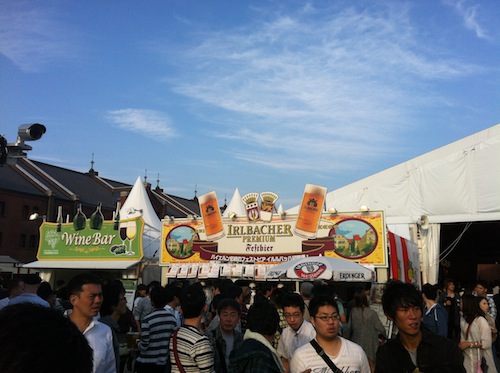
There were a couple moments the other day when I was reminded that Japan does things a little differently. It was about 7pm at the Yokohama Octoberfest, every seat was packed and people were clearly enjoying themselves when a couple of foreign guys stood atop their benches to greet the rest of the crowd. They promptly got a friendly response from all the other revelers but were just as quickly and politely told to sit down by security (a security I hadn’t even noticed until that point). They didn’t complain, they sat down with a smile and everyone carried on as normal.

That this only happened once in the few hours I was at the festival didn’t betray a lack of good times. On the contrary everyone was thoroughly enjoying themselves and when the German musicians came out to greet the tables outside the main tent they got a fantastic reception, glasses and arms swaying as we all cheered along.

So what was different about it all?

To me, I guess it simply felt more grown up.

I hesitate to use the phrase as to suggest that the Japanese are in someway more mature than other nations, to imply that kind of comparison between nations at all feels condescending.

The truth is that what I’m talking about isn’t maturity but a manifestation of culture.

Though people of a European or North American background make up less than 0.5% of the population in Japan the figure is marginally higher in Yokohama which prides itself on being an international city.

Nonetheless however, Yokohama is still overwhelmingly Japanese and as such so was yesterday’s event. Japanese culture, not an international mix was the dominant force in setting the atmosphere of the day and so I doubt 95% of the crowd would even consider for half a second, no matter how heartily they’d taken to the festivities or yards of Heineken they’d drunk (if the crowd wasn’t that international the choice of beer certainly was), clambering atop their bench and drawing all the attention of the other drinkers towards them.

What makes this even stranger is that this kind of behaviour, from a British point of view at least, ought to be more pronounced at a Japanese Octoberfest. That Far East Asian people often have a lower alcohol tolerance than other ethnic groups is a fairly commonly held conception (I wouldn’t like to make too much of a claim as to its veracity, anecdotally at least it seems to hold true…ish) as such shouldn’t there be more not less drunken shenanigans? Hell, even based on the lower average height and weight of the Japanese this ought to hold true.

Yet, no.

Not at all.

Once again I’m inclined to believe that culture trumps genetics because as Kate Fox of the SIRC (Social Issues Research Centre) noted in her episode of Four Thought  on the BBC last October, alcohol by and large has little to do with how we act as a nation when knocking back the booze. Far more powerful are the myths and narratives that we build around it. The self fulfilling prophecy that imbibing inevitably leads to putting a traffic cone atop a bus stop. Or as she rather more academically describes it,

“The effects of alcohol on behaviour are determined by cultural rules and norms, not by the chemical actions of ethanol.”

The article further mentions that countries like the UK and US have something called an ambivalent drinking culture, in that we assume all manners of behaviour, usually negative, to be the by product of alcohol consumption.  However, in Integrated cultures e.g. many Mediterranean countries, alcohol is seen as morally neutral  therefore these kinds of negative behaviour aren’t associated with alcohol consumption per say.

So where does that leave Japan?

Well, certainly many things that might be considered to be a moral matter here such as sex and gambling, aren’t viewed in quite the same way as they are in countries with a different religious background. Certainly alcohol isn’t seen to be as much of a moral issue as a practical issue.

Take a look at the decline in Salaryman pocket money over the years or the tradition of handing over one’s pay cheque directly to one’s wife in Japan for example. Men drinking too much isn’t so much a moral problem, it’s a practical one. There are home loans, children’s educational costs and taxes to pay first and if there’s something left over then the husband might be able to spend it on a night at an Izakaya.

There’s one problem with my argument though.

Yes, culture appears to dictate what is acceptable behaviour while drinking, however, while national cultures are persuasive in this way (and the Japanese have the proverb, “the nail that sticks out gets hammered down” for a reason) sub-cultures are equally if not more persuasive at times. So as you read about the surprising maturity evident at an Octoberfest event of all places, there is most probably a drunk salarayman asleep across four seats of the train disproving my foolish notion.

Shoganai ne.

Or as we say in English, ‘it can’t be helped, can it?’

Ah well, let’s just stop worrying and enjoy it shall we?

Cheers!