Category Archives: Japan

Tokyo 2020: An Honest Introduction?

I missed the London Olympics, in person at least. Watching from my sofa on the other side of the world I couldn’t quite believe the news at first. It wasn’t the gold medal haul that surprised me, rather the change in national spirit it seemed to engender. A pride at the things a small island nation could do and achieve. More importantly what we could strive to be. We could be an example of a modern and most importantly to my mind, a multi-cultural Britain. One that not only celebrated those differences but achieved more because of them.

It seems I might have a shot at experiencing that buzz in person after all. Tokyo is going to be hosting the 2020 Olympics and I couldn’t be happier for the nation I currently call home. I’m confident Japan will produce a marvel to match that put together in London. Having experienced Japanese fan culture first hand I know that the stadiums will be bouncing and the country will contract Olympic fever in pandemic proportions. It really will be something to behold.

In many ways though, I can’t help but hope that Japan does things a little differently to the UK.

Last year the Guardian wrote this in their editorial response to the games,

The Games have celebrated what is easy to take for granted: that for all its inequalities and struggles our society at its best can be a living example of tolerance and cohesion, of inclusion and possibility.

But looking on from afar I now see a UK that is ‘actively hostile’ to immigration and an immigration system in place that would turn away British friends and their Japanese spouses if they don’t have enough money in the bank.

An approach apparently designed to make sure,

“that spouses coming to live in the UK would not become reliant on the taxpayer for financial support and would be able to integrate effectively.” 

Which is obviously why the government has made that integration easier over the years by cutting funding to ESL courses.

Then just the other day a prominent English footballer got rather ambushed into making jingoistic remarks about what qualifies someone to play for England. He wasn’t saying anything xenophobic really but he probably didn’t realize just how blurred an issue national and ethnic identity is for many of us. Take one Ikechi Anya for example, the Glasgow born, Romanian/Nigerian who plays for the Scottish National football team.

I myself if I were any good at any particular sport would be eligible for the UK, England, Ireland, the USA and probably Japan under residency regulations.

Thankfully my lack of athletic prowess has spared me such a wrenching decision.

But jokes aside, it feels like I’m watching Britain turn its back on the very things we rightly celebrated. A nation built upon, and stronger for a sense of identity that goes beyond where you were born and from whence your grandparents came.

Japan however, isn’t exactly lauded for its sense of racial or ethnic diversity. I’m part of the 0.6% classed as other. The 0.5% and 0.4% of Korean and Chinese ethnicity that make up the rest of the other 1.5% of Japan that isn’t Japanese are in all likelihood third and fourth generation immigrants who know no other culture than that of Japan. As such Japan’s Olympics is probably going to be a celebration of a culture and identity that is far more simply defined.

Now, I’ll make this clear; it is very much a culture that should be celebrated and I look forward to seeing the very best of Japan come 2020 because I’ve already experienced it in the day to day kindness and goodwill offered to me. But I hope, that where Britain welcomed the world and then turned its back on it Japan will do otherwise.

What a legacy Japan could achieve if it not only celebrates the things that make Japan distinct and unique but openly looks to share that with the world and in the process widen the definition of what it is to be Japanese to include the best of other cultures too. Because some of those other cultures are already here, they are already making significant contributions to Japanese life. They raise families, they participate in the local community and they contribute in myriad untold ways to the growth of the nation.

In 2020 Japan will seek to introduce itself to the world.

Hopefully it’ll be an honest introduction.

And unlike Britain the rest of the World will be welcome for more than just the summer.
How Not to Climb Mt. Fuji

Perhaps we had taken too great a heed of the warnings. People cautioning us about the weather, the possible dangers along every path and most importantly, the sheer number of bloody people who attempt to reach the summit during O-bon.

It’s possible it was something else I suppose.

Maybe it was pre-altitude sickness, a little known condition that makes you giddy, foolish and liable to endanger your health while still at the approximate altitude of your sofa. Or might it be that we simply did not put all that much thought into the idea beyond, hey, it is right there, it’d be dumb not to, right?

It’s probably the latter but I’d be happy enough to blame the former if I can get away with it. Because while I’m sure the Internet is full of guides of How to Climb Mt. Fuji!

this, really isn’t that sort of manual.  

We didn’t under plan as such. I mean we certainly weren’t in any danger at any point, but we did vastly under plan compared to how the average Japanese person appears to approach this national-cum-world heritage ascent.

The average Japanese person scales Fuji-san, as the famous peak is known in Japan (and no it doesn’t mean they call him Mr. Fuji), with the full range of equipment one would associate with bearing the full brunt of the elements. Almost every single climber has the obligatory expensive coat, thermal trousers, hiking boots and at the very least a promotional Mt. Fuji climber’s walking stick if not two shiny, what I assume to be carbon fibre, walking sticks.

Now, should the weather take an appalling turn for the worse you might find yourself in need of approximately 50,000 yen’s worth of kit (about 350 pounds) but these people really aren’t the brave the elements type. Nope. These are tour group hikers who take the bus up to the fifth station on the easier trails and are up in about five hours and down in a couple by running down the ash path known as osunabashiri which gets them down to the new fifth station at Gotenba in under three hours easy. It’s mountain climbing for those who want the photograph and the stamp more than the actual experience. Achievement with the minimum of effort. Which makes sense I suppose, I mean you wouldn’t want to sweat in that new gear of yours would you?

Were my climbing partner and I of this ilk?

Ummmmm… not quite.

Were we of the other, conquer the world, abseil down the face of adversity and challenge a crocodile to a wrestle variety?

Definitely not.

We were the average, comparatively unprepared couple of guys who took the longest, steepest route not because it was there but because there would be less queuing and fewer tourists.   

We weren’t total idiots though. We did pop down to the local outdoor store to pick up a headlamp, which is of course necessary when starting the ascent at nine o’clock at night as we were. Though I imagine the whole route would be floodlit were it not for the requirements of World Heritage qualification. For those unaware of Japan’s religious predilections it’s worth noting that Shinto and Buddhism are actually Japan’s second and third most popular religions, Convenience coming in at number one at a Usain Bolt kind of canter.

We actually avoided one such shrine, 7-11 to be precise, but did make time to stop by a HAC Drug, or Health and Communication to give it’s full title. Because when I need to buy energy supplements and cereals bars to provide the power for scaling Fuji I clearly also need to consider my current household supply of slippers and notepads. So where else would I go?

So as you may have ascertained by this point we did indeed survive. Well armed with jelly, value mineral water and cereal bars how could we have failed?

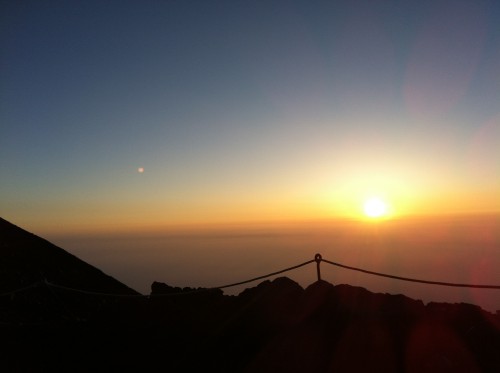
The ascent from the Gotenba New Fifth station took approximately ten hours and another five on the way down as we didn’t go the whole way down via the impressively steep ash and sand flats. We were utterly exhausted, aching all over. We caught the sunrise from the eighth station and then struggled on an hour or so more to the summit. I marched ahead of my friend on the ascent and then was made to look the old man as he made the descent with an effortless cool that my wincing from the pain in my knees couldn’t convey.

Was it worth all the hours of pain? The sweat, the aching limbs, the fine coating of dirt and dust that we were showered in upon our descent?

Definitely.

But the reason was down to good fortune rather than anything we did. The weather was fine. The night sky almost totally clear and sunrise was truly beautiful; all the more so after eight hours of climbing.

But, without that reward for all our efforts?

In that case, I might have been more typically British in regard to the experience.

I believe it always rains on Fujisan. The people who maintain that they saw anything on or from the top of it are people I should like to have witnesses against me, if I were tried for my life, rather than for me. The man who goes up once may be excused, if in other matters he is an average fool, so that you don’t expect much from him; the man who goes up twice should be put out of the world immediately he arrives at the bottom again; and the man who will induce his confiding friend to accompany him up, on any prospect or understanding, is own brother to Judas Iscariot.”  

Eight Years in Japan 1873-1881 by E.G. Holtman. p.231.

Poor chap, all he needed really was a spot of sunshine.

Sunrise from the eighth station.

Sunrise from the eighth station.

Thanks to my good friend over at MonkeyBrainSushi for sending me the link to the wonderful Mr. Holtman’s musings. Check out his blog for some stunning Japan photography. 

Filling a Sweet Tooth

The laser guided tool beeped. That can’t be a good thing can it? Beeping means it’s detected something. Nobody wants the dentist to find something worthy of beeping. Not if beeping is only a prelude to a more dreadful whirring, grinding noise.

26

No drilling.

Phew.

At what number and above do you need to drill?

30

Phew indeed.

…Beep…

This time?

99

Shit.

I am not, nor have I ever really been in possession of a sweet tooth. A salt and vinegar crisps tooth most certainly.  A beer tooth? Some might argue so. But, a sweet tooth? Never.

This was confirmed to me the other day when one of my favourite café’s changed its usual dining hours and I found myself tucking into decadently produced banana and nut pancakes in lieu of actual dinner. I might have slipped into a sugar induced coma in my seat had it not been for my teacher’s proclivity for caffeine beverages of all varieties. Instead the two joined forces and left me rather jittery instead.

The delivery system of my addiction.  Cheers Mum at http://www.shadesofchina.co.uk

The delivery system of my addiction.
Cheers Mum at http://www.shadesofchina.co.uk

So, as it turned out, this was to be my first actual filling not just in Japan but ever. This was not one of the many experiences I’d been dreaming of in the weeks before I first jetted out to Japan.

Golden Temples. Check.

Sushi. Check.

Dental procedures in a language that its own native speakers need rigorous instruction in?

Um, can I skip this part of the package tour please?

The dental nurse who usually takes care of me nipped off to consult with the dentist who almost immediately popped himself onto to a stool beside my chair. Quick chat, reassurance that it’d just be a little bit of drilling and so it wouldn’t hurt really. Fancy new stuff, no chunk of silvery stuff lodged in my jaw, done in twenty minutes, filling speed dried with some tiny heat lamp, towel over my face so the glare from the light above wouldn’t sting my eyes.

This doesn’t seem right to me; all this frosted glass, fancy technology, efficient service and punctuality. Maybe the fact that my local dentist feels a little bit like the shinkansen of dentistry shouldn’t surprise me as I do after all live in the land of the bullet train.

Yet, I don’t have to look far to find the reason I feel nonplussed by it all.

It used to look me right in the face, wipe snot on its shorts if not licking its nostrils clean and stunningly flash a set of gnashers that might cause one of the waxwork models at the Jorvik Viking centre to reconsider flossing.

Yes, otherwise adorable little munchkins who just occasionally try to ram a sly digit up your backside when you’re not watching them, often giggle and grin to reveal teeth utterly rotten and possibly harvested for use in pirate movies and historical accurate Dickensian drama.

Why?

I haven’t the faintest.

Dentists seem to be fairly plentiful. Adults and teenagers alike both make use of braces and eschew them in many cases where teenagers in the UK or US might be desperate for a reconstruction job. Supermarkets sell all manner of dental hygiene stuff and beautiful gleaming smiles assault me from advertising hoardings.

Maybe it’s just not seen to be a necessity by some folks.

Perhaps a perfect set of choppers isn’t an absolute requirement for a well-adjusted life after all.

Whatever the answer, I think I’ll just continue to enjoy the fine service as much as I can and simply do my best not to leap a mile when a four year old smiles at me like an intern at Fagin’s financial services.

Cold Shoulders and Pocket Tissues

I have newfound sympathy for the tissue dispensers of Japan.

Ok that sounds a bit odd so here’s the explanation for anyone who hasn’t had a chance to wander the streets of Japan.

The humble flyer or pamphlet may be king in your part of the world but here in Japan the pocket pack of tissues reigns supreme. It’s unsurprising really in a nation so concerned with allergies, the flu and even the slightest case of the sniffles that they will don a mask without a moment’s hesitation that tissues would become the predominant force of street level advertising. Wander down any street in a major city, or in fact along any route with guaranteed foot traffic, say the front of a train station or the path leading to a university and you’re sure to encounter someone trying to hand you pocket tissues emblazoned with advertising.

In the past I’ve smiled, shook a hand, told them, “I’m ok thanks.”

Never again.

Last weekend in Tokyo after doing some pre-wedding dance rehearsals, not my wedding, right by the entrance in Yoyogi Park I figured I’d managed my quota for mild embarrassment for the day.

Nope.

One of the dancers that day is the man behind Sayonara Speed Tribes. We have a mutual friend and having met while playing poker, using pistachio nut shells in lieu of chips, we evidently know each other well enough for myself and the soon to be betrothed buddy of ours to be roped into handing out flyers/postcards for the screening of the documentary that night in Shimokitazawa.

So outside Yoyogi, quite possibly illegally, we set to the task of dispensing with a stack of around thirty postcards each, alternating between basic Japanese and English when we saw non-Japanese faces we tried to flog every last one of them.

Bousouzoku dokumentari de gozaimussssssssss.

Biker gangs in Japan documentary!

So how’d it go?

Well, it may have been a lovely spring day but boy did it feel frosty.

We were snidely laughed at by young Japanese men who thought it hilarious that a foreigner was handing out flyers and/or speaking Japanese.

We were flat out ignored by many people who simply refused to acknowledge our mere existence.

The young men did that too; it was quite the double act.

We were even dodged like the possessor of some virulent disease, the pedestrian taking an almost comically wide berth as they evaded our attention afraid we might breath advertising on them.

It was a nice reminder of why I often enjoy small city life so much. It’s not just being a little further south that makes where I live a bit warmer.

On the other hand though, some people did stop. Some even spoke. It wasn’t unrelenting cold shoulders and that made all the difference. Ten people in a row flat out ignoring you really is made all the easier by just one person paying the slightest bit of notice to you. Saying something, even if it’s saying, “no thanks” or just smiling and shaking their head makes an otherwise thankless task so much easier.

So if you took a flyer off me on Saturday, thank you!

And if you saw me dancing in the park… then let’s just pretend I was trying to give you a flyer.

Sayonara Speed Tribes on DVD.

Sayonara Speed Tribes on DVD.

Find out more about the movie and buy the dvd here.

Sayonara Speed Tribes

Bosozoku

Bosozoku.

I can remember the first time I uttered the word in public. My class of elderly ladies giggled. My useless textbook had translated the term unbelievably loosely as teenager. It was frankly, a shit translation.

Sayonara Speed Tribes does a far better job of conveying what the word means; what it is coming to mean.

Literally the term bou-sou-zoku (暴走族) translates as violent-speed-tribe. It was a handy term coined by Japanese newspapers during the heyday of the biker gangs that emerged in post war Japan to describe the loitering youths, the joyrides on motorbikes and the violent clashes that occurred when these groups crossed paths.

By the 70s these groups, like all subcultures tend to become, were highly ritualized and ironically as subcultures always seem to do reproduced much of what they claimed to be abandoning and rejecting.

These bosozoku wore the uniforms of kamikaze pilots, ran their gangs in shades of samurai honour and enforced the sense of senpai and kohai that remains a dominant thread in Japanese life. They even retired from service, slipping either into the normal life of salary man or the criminal world of the Yakuza.

To me, the whole thing bears a disturbing if occasionally comical resemblance to a high school club. The uniforms, the training, the ritual, the respect for one’s elders and the necessity of carrying on the torch for them when they leave are all hallmarks of the life they apparently reject.

But things are changing.

Modern police tactics and the passing of time have led to a steep decline in bosozoku numbers and a move from violent outcry of youth and rebellion to pick and mix cultural identity.

It’s at this point where Sayonara Speed Tribes picks up the story.

Sayonara Speed Tribes follows the path of someone who stands with a foot in both worlds.

That someone is Hazuki, a legend within the bosozoku world. He is also a man left stranded by how quickly that world has changed, by how much he himself is desperate to change.

Fascinatingly, Hazuki lets filmmaker Jamie Morris into his life and allows him to see the changes he’s trying to make, the life he’s fighting so hard to build as at the age of forty he attempts to leave the world of bosozoku and Yakuza behind in order to follow his childhood dream into the kickboxing ring and beyond.

It’s an at times funny and moving documentary as Hazuki proves to be the perfect thread to follow between the past and the present realities of these groups. A charming figure, it’s hard not to root for him, not to hope that he’ll find the happiness and respect he craves.

Yet, Hazuki bears all the markings of his tribes, the tattoos and the scars of violence. In trying to leave his youthful world behind he still cannot shed the signs of his past life and rebuild.

For all that struggle though, I recommend you watch him try.

To learn more about the fine folk behind this documentary visit Figure8 Productions.

A Foreigner in my Own Bed

A single beam of light slipped through into the room as the shoji (Japanese style sliding door) crept open just a few centimeters. I bolted awake. It wasn’t my own bed I was asleep in; I was staying at a friend’s family home for the night and was currently enjoying that first night of sleep common to hotel rooms, half asleep, half awake and keenly aware of the foreignness of my surroundings.

And that’s before you factor in the tatami floor and shoji.

I heard a scraping. A flash of it, hurried, earnest and utterly new to me.

What manner of guest had snuck into the guest bedroom in the dead of night?

What on earth produced such a rapid burst of scratching?

“Mary?”

And with that her cold wet nose, shining eyes and panting mouth were face to face with me as I lurched back on the futon in surprise.

Evidently tiny dogs named after biblical figures are more than capable of opening sliding doors and scaring the bejesus out of me.

I suppose it’s to be expected. Staying in unfamiliar surroundings often leads to such moments.

Then there’s the danger that occurs from making familiar surroundings unfamiliar.  Salarymen generally achieve this by getting blind drunk and forgetting what apartment they live in within your nondescript box of a building and thus stumble drunkly into your room only to discover that not only is the contents of said room foreign to them but so is the resident.

I’ve never forgotten to lock my door after that.

So when I eventually venture back to the UK from time to time you’d think I’d find some comfort in the familiarity of home. My old bed, the absence of endless crickets chirping throughout the summer, the double-glazing cutting out most of the outside world should all lead to a peaceful night’s slumber for my wearied jet lagged limbs.

But the door creaked on its hinges. It swung open with a bang. That familiar noise transported from tatami mats to Matt’s wooden floors. No futon but the opportunity to launch beneath the bed before I could catch a glimpse of my early morning visitor.

For *#%*’s sake… Rodney…

I shuffled away from my pillow to lean over the bed and look beneath, found nothing, wondered where the hell he’d got to (cut me some slack, this is a pre-coffee story) and then promptly saw him peek out from the other side of the bed before darting out of sight. I clicked my fingers on the right side of the bed hoping to lead him out to the door. Evidently my sister uses clicking as a signal for something else because I immediately heard a mad dash, crash and whump as he landed in the bed behind me. I turned to find him across my pillow, laying on his back, paws pulled up and a quizzical expression etched across his mug that that seemed to say,

“What? I’ve been here the whole time.”

And he had.

My bed, my futon, was back in Japan.

This one belonged to Rodney now.

You bed stealing little...

You bed stealing little…