When Aliens Try to Poke Aliens: How to survive a trip to the hospital in Japan

The face goes blank, the eyes widen and an arm stretches out, index finger leading as if to greet ET. He’s slipped into automated curiosity, an autopilot for exploring the world around him, activated by the presence of anything new or out of the ordinary. At five years old that’s pretty much everything he sees. Under normal circumstances it’s a good thing. A biological imperative to learn, develop and understand the world around him. Today, for me, that’s a problem. Today I have a fresh scar on my neck concealed beneath a large white bandage that might as well be a giant red button and he’s heading straight for it.

Perhaps I should explain how I got here. About a month before that kids finger began to make a beeline for some very tender and fresh scar tissue I was sitting in the Doctor’s office in a small clinic at the heart of the Izu Peninsula. What had brought me here was my third cold of the year. I teach at a day care centre, catching a cold every couple months is pretty much a quarterly contractual obligation, so usually nothing to write home about. Except in this case it had had something of a knock on effect. It had caused a small epidermal cyst in my neck to double in size and so I made my journey to the heart of Izu, to this tiny rather ramshackle clinic, to begin my guided tour through the Japanese health service.

Alongside me in that room, aside from myself, my friend and the doctor were a pharmacist, another patient behind a curtain and three nurses whose sole job appeared to be smiling at me with their heads at a jaunty yet unthreatening thirty-five degree angle. In smaller towns, where the tone of your skin is liable to make you something of a B-list celebrity, it’s perhaps better to forget all thoughts of privacy.

Well-worn cliché number one, Japanese people stare at foreigners, now attended to we move onto number two; the notoriously low English level of the Japanese. How low? Well, my first Doctor’s professional thoughts as to my treatment were that,

“Considering the language difficulty, I recommend you go home.”

Hardly what you want to hear when you’re speaking to a doctor. Especially so when a return trip home is liable to set you back a thousand pounds and result in the loss of your job by your absence. Particularly when you are legally obliged to pay into the very health system that has just decided to inform you, in Japanese, that even though you have barely uttered a word of English to the doctor, that despite turning up with a Japanese friend willing to translate for you, that the doctor’s phobia of the English language is so great you ought to consider repatriation.

Having ignored this advice and moved onto a larger hospital, with a letter of recommendation from the first Doc (she was freaked out by English, not unprofessional), I’ve since made it out of the Japanese health system alive and well. Aside from the suggestion of flying over two thousands back home for a minor medical ailment, I’ve had a positive if somewhat complicated experience. So here’s some advice for those who’ve yet to venture down the red tape, rabbit hole.

Work on your Kanji

Let’s face it, Kanji (Chinese characters) is hard. Not impossible, but reaching the level of competency required to understand medical Japanese is going to be pretty far in your future. So if you live outside of any major metropolitan area in Japan and your Japanese isn’t fully up to scratch you’re going need a native speaking friend or co-worker to help guide you through all this, because while foreigners in Japan are legally obliged to pay into the national health insurance scheme there doesn’t seem to be much in the way of English, Portuguese or Chinese language help. No one is looking for an on call translator, but the odd bit of multi-lingual paperwork would be helpful.

That Japan has only recently introduced full time translators to its major airports would suggest that help for those who haven’t mastered their Japanese quite yet might be some time coming. An ethnic Japanese population of around 98% might suggest it might not even arrive at all.

Generational Issues

The one thing I really wasn’t expecting, aside from the suggestion I get my minor ailment treated back in England to save on language difficulties, was how much my ability to understand my doctor’s Japanese would change from person to person.

My first Doctor, age fifty something, 70% understanding.

My second Doctor, age thirty something, 80% understanding.

My third Doctor, twenty something… 0%.

Take a moment to consider how you, your parents and your grandparents speak. Same language but great, impossibly deep chasms can separate the young from the old in terms of syntax and phrasing.

In this case my third Doctor sounded like she majored in cuteness at Hello Kitty University. Her conversation may have been peppered with the cute linguistic, idiosyncrasies of the young in a country obsessed by all things, ‘Kawaii’ (Japanese for cute), but there is something quite disturbing in having someone who could voice a Muppet inform you of the length of the scar you’re about to receive.

Even more staring than usual

Whatever your problem is, pray it isn’t sexual or highly visible. Particularly if like many English speaking foreigners working in Japan you’re a teacher. Because your students are going to ask what’s wrong, your colleagues will ask what’s wrong and then your boss will.

If it’s visible, as the bandage on my neck was, prepare to be stared at even more than usual.

This place is not designed for the likes of you

No not foreigners, though we certainly aren’t at the top of the list of people to consider. I mean anyone under sixty-five. When I arrived in the waiting room of a hospital early one morning, ticket stub in hand to wait for my turn with the doctor, I realized that at precisely eight in the morning I was the only person below retirement age in an utterly jam-packed waiting room.

There’s a fairly simple reason for this phenomenon in my inaka (countryside) hospital; you can’t make appointments or advanced reservations. It’s first come first served and the old folks are up and waiting outside that doctor’s door at six a.m. on the dot. All this despite the fact that that doctor’s door will not open until exactly eight a.m.

And finally, for those who teach… have cat like reflexes

I teach at a day care centre once a week. It has its up and downsides. Upside, enthusiastic, endlessly entertaining kids. Downside, they don’t know what personal space is. Nor are their social skills too refined by age five.

As such when entering a classroom I got a, “ Hello Masshu (my name once Japanafied) Sen…. ehhh.” That final ‘ehhh’ was delivered with a pretty impressive synchronized head tilt and thirty little faces that screamed, why the hell is there a bandage on your neck!

But this isn’t sympathy, it’s curiosity and while this kind of curiosity is unlikely to lead you to such a fate as enjoyed by overly inquisitive felines it is liable to attempt to jab you wherever it hurts.

Maybe that’s not such a bad thing though, considering where they usually try to poke you.

A Mere Puppet

I see it coming, bathed in a gloopy, sticky mix of snot and spit, that one year old hand reaching out to brush my fur. That toothless smile, cute to everyone but me, wrapped in a onesie picked out by someone whose interpretation of cuteness by dint of biology doesn’t extend to realizing their own spawn looks like a toothless carnie on an opium trip.

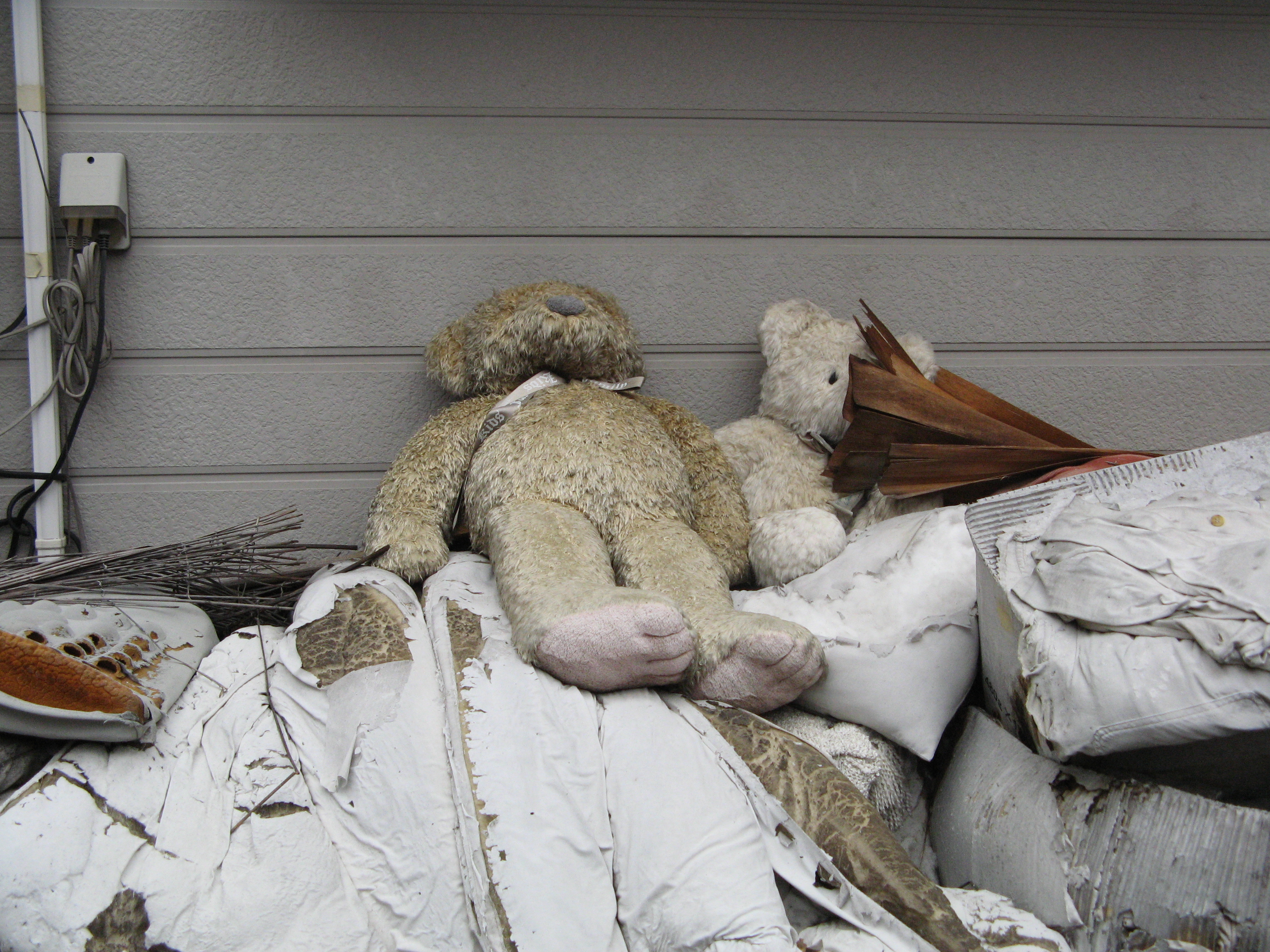
My only glimpse of freedom once a week and it’s spent being thrust, nose first into the path of a mumbling pup. These infants that lack the dexterity to even muster a thumbs up, clutch at my fur, tear at my plastic eyes all the while my owner has his thumbs and fingers directing my arms from the inside.

I’m nothing but a cheap, Chinese manufactured pawn.

One can’t help where one is, ‘made in.’

Look at how simply they bumble the basics of this tongue that I have mastered without even the necessary appendage. They stare in wonder as I command the English language with the energy and clarity of a young Oxbridge gent. Words slide from my maw with such ease that one might even question the need for a tongue or voice box when perhaps all one might need is a squeaker.

I don’t suffer alone. My kind can be found in plastic boxes far and wide, stuffed in the back of cupboards; forgotten and at peace in the dark of a bin liner in the attic if providence has shined on them.

My companion in this macabre tale is a yellow-feathered fowl hailing from the Americas. He claims to know of the green frog I so revere. Says he is friends with him even. He doesn’t fool me, his name betrayed by the irony of his meagre stature. His delusions I can forgive though. He has lived this life longer than I, born the brunt of mucus coated fingers and thumbs, the incessant and painful wail of their collective greeting.

Haaaa-rooo

I feel shame that I cannot even begin to describe at this existence. I bring happiness but at what cost to myself? The very stuff that makes me me (my stuffing), is slipping away day by day.

Soon I’ll be an empty shell, fit for nothing but the storage of pajamas, a hot water bottle cozy if I’m one of the lucky ones.

I doubt I shall be lucky enough to feel warmth beneath my fur again; this life has left me cold. I’d rather throw myself to the pre-schoolers and let them tear me limb from once fluffy limb.

Alas, I fear this frightful charade shall continue until my jailer sees fit to throw me to the recycling van or leave me to the elements.

A  puppet can pray, can it not?

Just Because: The Eloquent Misuse

“How can I refuse, such an eloquent misuse of a phrase.” Idlewild

I always thought that it would creep up on me like a slightly balding panther, stealthily, sneaking, claws primed to strike and slash away a crop of young, thick hair from my growing brow. Growing brow, I prefer that phrase to gradually receding hairline. It proffers more of a sense of victory than the defeatist linguistic equivalents of retreat.

Yes, there was always going to be a point of no return when it came to turning into my father. I figured in my teenage years that it would be the day I finally received the sort of hairline that the Japanese playfully refer to as resembling Mt. Fuji. Inevitably the attack arrived, but as it turned out, my father’s influence on me has shorn through linguistically rather than in a follicle sense.

Well so far at least.

It is a phrase wielded with ease by parents everywhere when the exhaustion of offering yet another explanation is too much to bear. At other times it’s just the quickest way of stating that something ‘is’ and won’t be changing simply because your adolescent mind is unable to fathom that the logic at work isn’t about to shift at your request.

“Because.”

Children have daily experience with, “because,” adults; not so much. As such, explaining this concept to an adult requires a touch more finesse. Sometimes I can offer a reason for a way of phrasing something and other times the mind simply boggles and I have to um, ahh, well, etooo (Japanese for um) and anoooo (Japanese for ahh) my way through a thicket of hedging to reach my point.

That point being, that I’m afraid it’s just the way it is. We ride on a train, on a bus and in a car. I know how ridiculous it sounds to a foreign listener and I sympathize but even if I knew the etymology of every jumbled bit of English language I can’t always translate it into Japanese. Even if I could I probably can’t tell you why most of the time because even linguists haven’t the faintest.

Inevitably, the final roadblock is socialization. All those times that everyone is told “because” in his or her youth has only served to hardwire in a certain fashion of thinking. So when that hardwiring comes into contact with the ancient foundations of a language, itself a tangle of roots and branches long untouched by a gardener, well it has a little problem coping sometimes.

In practical terms there is such a thing as correct way to say something, yet the nebulous nature of language means that it may not always remain that way. The beauty of language is that it is alive, it evolves and adjusts to its surroundings, bends and flexes in delightful new ways that thrill the poet and leave the pedant aghast; often one and the same person.

Sadly, many of my students tend to fall into one category or the other when they are dealing with English. I have students of all levels who take great delight in the peculiar logic behind idioms. Others who question why they simply can’t lean on their stock phrases for every situation.

In these cases my decision to tell them “because” comes down to the degree to which their freedom with, or lack of interest in the nuance, of the English language is likely to lead them into trouble or embarrassment.

Now, English, unlike Japanese, is an international language. As much as it may pain me to say it, it does not belong to England. It left home long ago and has grown up perfectly fine without its parent leaning over its shoulder. So I try to tell my more advanced students not to worry, that their phrasing, so long as their meaning is clear is perfectly valid, it’s their English and they can use it generally speaking, however they like.

Then a different problem rears its head,

“But teacher, we want to say it like a native speaker!”


Sentimental Sake:The Perils of a Late Night Beer Run

Every time I buy beer at precisely 9:55 in the evening I feel nostalgic, almost wistful. I begin to think about all the things I’ve done with my life, the myriad of things I’ve dreamt about that I haven’t even begun to get close to.

I start to plan and plot the months and years ahead. I make promises to myself. I challenge myself to do more with my time here in Japan, to take risks, travel and throw myself into the culture, to spend my money on something innately Japanese, to save more money for the day I eventually go back to England.

All these things pile up around my head as I make my way to the checkout, hand over my points card (it’s the second Japanese economy), exchange pleasantries with the staff who now know my face well enough to smile and bow from three tills away, hand over my cash, drop the six pack of Japanese lager into my reusable shopping bag and make my way to do the door wondering why all Japanese supermarkets have to play the tune of ‘Old Lang Syne’ at closing time.

Then I open my first can and forget every single resolution I just made in the ten minutes it took me to walk to the supermarket and back for a few beers after work.

Until the next time I’m greeted by an alcohol free fridge at least…

Nyaaaa-go: a Tale of Mice and Capital Punishment

“Nyaaa-go!” Screamed the slightly portly, middle-aged man dressed as a cat, his brightly coloured t-shirt somewhat detracting from his fearsome countenance. “Nyaa-go,” repeated the three women dressed as mice in a slightly higher pitched tone who then promptly collapsed into well-rehearsed giggles.

This was the opening act in the auditorium at the local International Friendship Fair.

The moral of said story, at first glance, appeared to be quite simple; if you’re a mouse and you meet a cat that says, “Nyaaa-go,” start running as fast as your wee little mouse legs can carry you.

Evidently, having missed this advice from the mouse teacher earlier in the play this performance wasn’t about to be about the savage mauling and devouring of three little mice as a hundred or so children looked on in terror as prop blood squirted from the stage, tiny mice bodies twitching in the spotlight.

No this was much lighter Japanese fare. The motto essentially being, if you overload your unknown foe with kindness, in this case more fruit than he can possible carry, you will have successfully prevented them through your excess of gift giving from snapping your tiny mouse bones. Saved from your ignorance by sweetness. I took it to mean, if a stranger offers you sweeties, offer them a whole advent calendar and there’s no way they’ll do anything untoward to you, that’d just be rude.

As the tale of the practical, moral-phobic mice drew to a close it was time for the high school debate teams to take the stage. Obviously, with this being the International Friendship Fair, one cute event would just roll into the next.

So the ‘The Death Penalty in Japan’ it was.

Actually, this was why I was in the audience. Specifically the front row, feeling probably about half as nervous as the eight teenagers on stage who were about to take to their feet one by one to debate for and against a moral quandary that would no doubt send there heads spinning in circles. Not because of the ethical aspect but rather the fact that it was all to be delivered in English. Hence my presence as a judge. Not an especially well titled one mind you.

“We have ______ san, the Principal of _________ school, then ___________ a undergrad at___________ studying English and finally… Matt!’

My nerves and embarrassment of that particularly stunning introduction aside, I should relay something to you just to give a sense of how nerve-wrackingly difficult this event would be for the kids.

One day, having spent the past three hours studying Japanese in a coffee shop in town I strode into my local bar feeling far too pleased with myself for the short lived burst of effort and energy in a more studious direction. Immediately I was met by the following sentence from a non-English speaking Japanese friend, “Masshu, Masshu, according to this Russian newspaper aliens are coming to Japan next year!”

Awww bollocks.

I hadn’t the faintest idea how to even begin discuss a subject like this in Japanese. I know the words for Alien, UFO and space but I certainly can’t discuss the finer points of alien abduction or conspiracy theories in Japanese.

So now think about these kids. Yes, if they are taking part in a National English Debate Competition it’s fair to say they’ve been born into a certain amount of privilege. Yet that doesn’t lessen my sympathy for the task they faced. Some of these kids were still clearly streets ahead of their fellow teammates; due to time spent abroad or international parents some kids could run linguistic rings around the others. Though inevitably it would all boil down to their own hard work, as our judgement was to be based largely on the strength of their arguments, not linguistic merit.

Now even if one or two teenagers particularly stood out due to their linguistic prowess I was thoroughly impressed with them all. The argument alone is hard enough but finding the words to express oneself eloquently in another language is incredibly tough. To do so in front of a crowd is brave and admirable.

If I had been similarly confronted by this situation as a teenager or even now I think my response would be the same.

Just shout, “Nyaaa-go” and make a dash for stage left.

Eikaiwa: The Art of Teaching off the Menu aka Fast Food English

Mine is a funny old business. I am and have been for the last two years an English teacher in Japan. Specifically a teacher in the permanently gaffe filled, artfully mismanaged land of English Conversation schools otherwise known in Japan as Eikaiwa. It can be and often is a wonderful job yet inevitably as all jobs do, it has its downside.

That downside is a problem that the industry as a whole has struggled to solve. Coincidently it’s also a problem that Japan as a whole has struggled to solve. You see, while Japan is filled with people with a passion for travel, foreign cuisine and all things Lady Gaga; not that many people actually want to speak English.

Well it’s not that they don’t want to speak the language, it’s that they don’t want to study it. You see, the Japanese system of teaching English in schools is so utterly old fashioned and in many cases remarkably dull (the approach, not the teachers themselves. Like anywhere there’s inspirational ones and ones that ought to have been wheeled into retirement long ago) that the sight of anything that looks vaguely challenging on a whiteboard elicits whines of, “muzukashii” (difficult) or, “muri” (impossible, can’t do it, argggh!). More often than not this terror is followed by understanding all of two minutes later.

However, the initial fear is what most students tend to remember. Not the success that followed but the thought of failure that preceded it. Years of endless grammar study, direct translations and filling in the gaps has led to generation after generation of Japanese who believe that anything that might resemble a classroom approach is simply beyond them and certainly not enjoyable nor necessarily effective.

Japanese schools most notably achieve this utter lack of confidence by focusing the bare minimum on conversation. Which in turn leads many people in Japan to the English Conversation School, where we do our best to pick up the pieces.

The problem however then becomes something different altogether. Simply put, we’re not an academic institution or a school in any normal sense of the word. In fact when one considers the ubiquitous nature of Eikaiwas in Japan our business probably has more in common with a mismanaged fast food chain than anything else.  This is because while we all promise the same product, we go about preparing it in a variety of ways.

The reason for this isn’t entirely the fault of the industry itself (admittedly a fair chunk is), but rather the demands which students place upon it. For example, particularly older students wish to study in the same class as their friends regardless of the vast differences in the English ability. Much the same happens with children and while in some cases that age difference or ability gap makes not one jot of difference, if you’re using a text book of any kind then you’re going to be spending your time flitting from student to student trying to help them with their individual problems as opposed to teaching a whole class together.

To make use of the fast food analogy again, it’s like people walking into a McDonalds only to order a family chicken bucket, a flame grilled whopper and a side of hors d’oeuvres. We’re continually demanded to teach off the menu.

Everyone is making different demands of the industry and requiring it to cater to their particular needs, but continue to treat learning English as if it is a passive act, one in which they themselves will place all the work on the teacher’s shoulders to individually prepare.

Now most of us are happy to do that. I’m not saying that we’re perfect, like any industry we have our stars and our not so shining examples. But by and large we’ll do our best to cater to the students’ various (and they are various) whims, wishes, desires and dreams.

Yet, the one thing that makes all the difference is rarely addressed; the ingredients we work with. One visit a week to an English conversation school is never going to bring you to fluency unless you put in the hours and hours of self-study required.  We don’t care how you do it, watch movies, listen to the abundant free lessons provided by NHK, pick up a dirt cheap copy of any number of text books, use the internet, watch TV shows (my fastest progressing student is a twelve year old Hannah Montana fan) make twitter friends or listen to music, just show up having done something. Because if you bring us something, anything at all, we can teach you relevant, interesting English, the grammar and language you need to express yourself.

However, if you put all the effort of buying a Big Mac into your study of the English language, don’t be surprised when all you get is indigestion.