Category Archives: Uncategorized

Pachinko: The Cost of Solitude

They can be found everywhere in Japan. In major cities and in the sleepy countryside alike, the sound of high pitched ringing and pinging flows out of automatic doors as they open to let some poor bespectacled salary man back into the harsh light of day, far from the neon buzz and cacophony of electronic noises of his temporary home and refuge, the Pachinko parlour.

What is Pachinko you may ask? It’s a question I’ve asked my students many times and, “a sort of pinball,” is the only answer I’ve ever received as they remain strangely non-committal in their answers. A way to lose money while being assaulted by flashing lights and random video sequences to build up suspense would have been my guess, but such is their popularity in Japan I’m inclined to believe I may be missing part of their appeal.

According to the Japan Times the game evolved from an American Pinball machine originally exported to Japan to be sold as a children’s toy. Over time the humble pinball machine became an adult’s game and something of a gambling phenomenon.

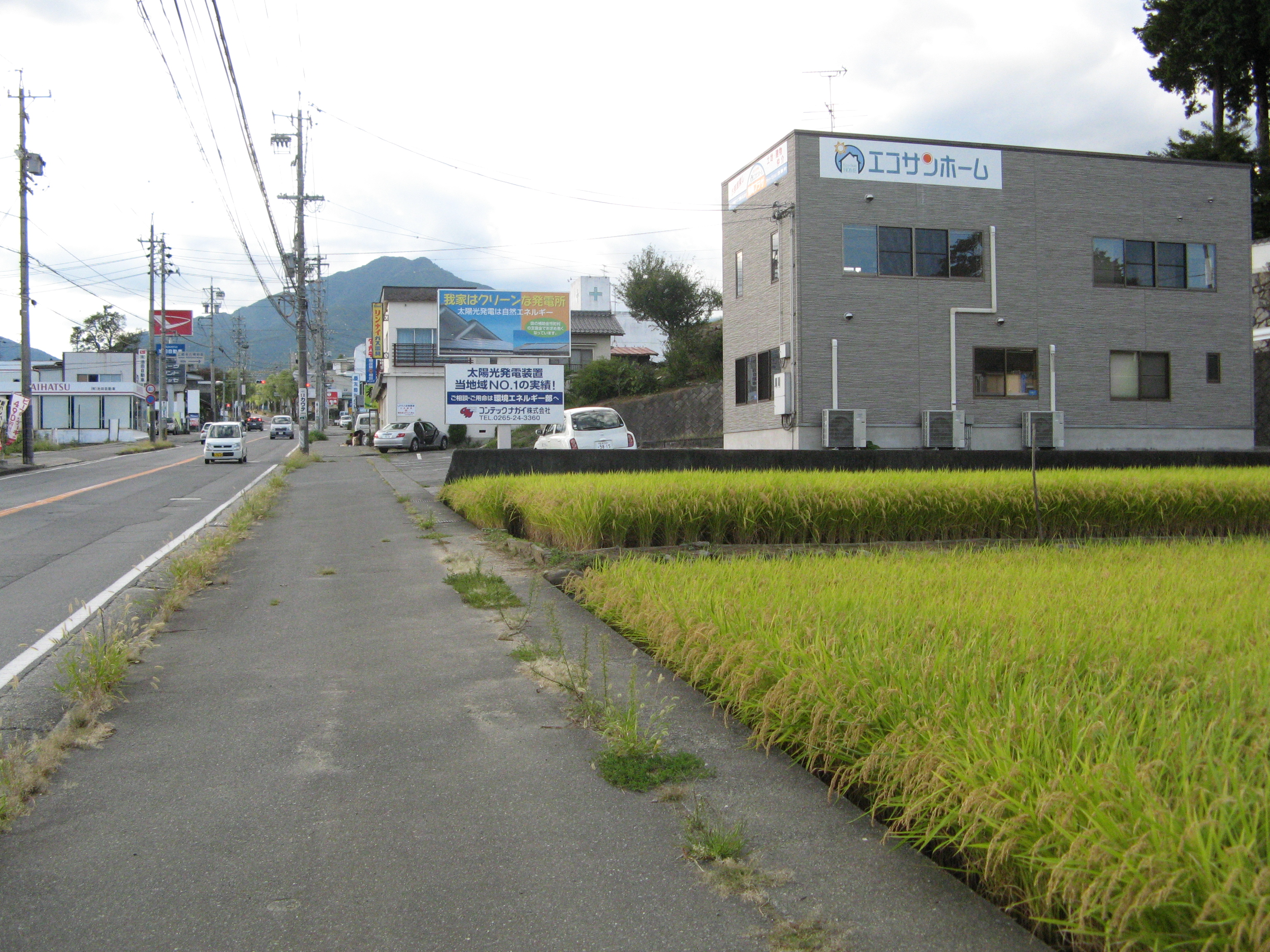
How much of a phenomenon? Well, two minutes down the road from my apartment, on an otherwise non-descript yet quiet (for just how quiet, see the below picture) road leading in one direction to the highway and in the other to the quiet city centre, sits a fairly typical Pachinko parlour. It has as many parking spaces as the local supermarket and unlike the supermarket they seem to be in demand every moment of the day. They can be found in every city and in my travels I find them to be almost everywhere where one can find a space to build one; in a form of architecture that can only be described as Buck Rodgers style modernism.
Their names are usually snippets of English, something that hints at victory and competition, for example ‘Champion’. Anime or Manga style art often play a role in the signage lending an air of fiction to the places. I suppose it adds to the feeling of a different world that casinos often try to create in order to keep gamblers at their tables through the night by making sure the environment remains the same no matter the time of day. It also on a far more obvious level taps into the general adoration of all things Manga.

Yet, while I can see the Pachinko machine’s roots in pinball, as it looks essentially like a vertical pinball machine with added things to twist and push and generally confuse and distract its players with, it has evolved into something all the more confusing and inherently Japanese in its design. In fact if I had to describe it to someone my best attempt would be Akihabara in a box. A neon cacophony dedicated to the art of switching off from the hustle and bustle of life itself.

The game itself is appallingly simple. You rent little pachinko balls (think pinballs) for around four yen a ball, so a thousand yen note will get you about 250 balls. The aim is simply to win more balls which allows you more opportunities to get them to drop into the central gate that then activates the slot machine element of the game that allows you to win yet larger prizes. To get a considerably more detailed overview of how the game works, check out the Wikipedia Pachinko page.

However, while they may be on almost every other street in Japan they are not necessarily all doing quite so well. Nationally Pachinko is actually worth more than Japan’s domestic auto industry and an individual parlour can easily make $25 million dollars a year. Yet, despite these huge figures, on my regular drive to lessons I pass two empty, creaking and dilapidated Pachinko relics. Thanks to their distinctive design no one appears to have any interest in reusing the buildings themselves. A friend of mine has even noticed one such Pachinko palour is currently filled with the product of this years rice harvest. A gambling den converted for use into a grain silo of sorts.

The house, clearly, always wins, unless as in the case of the latterly mentioned derelicts, the house is too big for the area it resides in. But the size and number of them in my otherwise sleepy little city suggests that these colossal gambling halls, are on the one hand incredibly popular and the other, very profitable indeed.

When my friend played the other day, in an attempt to fathom what the hell the appeal of these machines was he dropped a hundred yen in a low risk, low win machine that lasted as a game for all of fifty seconds. However, people will spend hours upon hours in these places and rarely beat the house and if they do only by a measly margin.

How much, is a moment of solitude costing the average Japanese person who indulges in Pachinko? According to The Japan Times in a 2007 article, “a YRI survey of about 2,000 respondents conducted between September and October in 2006 found that the average amount spent on pachinko was a whopping ¥28,124 per visit.” In pounds, for my English readers, that comes to a whopping, £214.67.

As David Plotz notes in his article on Pachinko in Japan (and it only exists in Japan) the all-pervasive, easy access and economically draining variety of gambling that it takes the form of (in contrast to the economic and tourist draw of places like Las Vegas) is seen by academics to be the worst kind of gambling in a society from an economic standpoint. What does that mean exactly? Well you’d happily fly to Las Vegas, see a show, eat some fine foods, drink some colourful cocktails and generally have a good time. Possibly even, without gambling a single penny, but no one is flying to Japan for Pachinko.Certainly not for the parlours in my city.

The strange thing is, technically, gambling is illegal in Japan. Yet, Pachinko operates in a grey area where it is generally ignored and loosely regulated. There is no moral distain for Pachinko as far as I can tell in my day-to-day life and so as noted in the fantastic piece on Pachinko on the New York Japan Society website by David Plotz, Pachinko is treated like many other vices in Japan, as a purely practical issue.

The nervous shuffling from my students when I from time to time ask them certain questions is usually pretty indicative of unspoken elements of Japanese society that they know to be logically harmful, perhaps even shameful but to which they turn a blind eye. That personally the appeal of Pachinko remains elusive to me is obvious, I come from a generation and a culture with other means of escape from the daily grind; indeed not being Japanese I don’t believe the daily need be a grind at all. Yet, that shuffling persists because while I cannot discern the comfort one receives from the abandonment of self in somewhere as noisy and crowded as a Pachinko Parlour (if only for that brief few hours a day to maintain one’s own sanity and separateness from the solid whole that is Japanese society), it is simple to discern something that the Japanese know too well already. That a practical response to something damaging, is nothing to be ashamed of, but if that solution includes the desire to pretend it doesn’t exist at all, to never discuss it in real detail then it will be left to fester all the worse.

When Japanese Kawaii! Culture goes a little too far…

Walking back from taking the pictures for this article, I passed by a stonemason’s that deals primarily in gravestones.  These kinds of places are scattered quite openly around Japan and are fairly easy to come by, indeed I pass by one with an enormous nine-foot tall figure outside in lieu of an actual sign when I drive to certain lessons.  I’ve always been rather impressed by the craftsmanship and obvious skill involved. In a country so full of flashes of neon it’s nice to come across something of the traditional and understated from time to time. Something respectful of its heritage, not gaudy when it should be gracious.

But then I saw something less funereal, more furry… he does look rather dapper though.

The Tuna Taboo: Who ate all the tuna?

Sushi. Sashimi. Both delicious, both abundantly available in supermarkets and restaurants across Japan and of such a quality and price as to ensure that the next time I take a seat at a Yo!Sushi in Britain I know I will be left poverty stricken and disappointed. Prepared perfectly, there are few things that compare in my mind to maguro sashimi (raw tuna).

It elicits a similar response in all my students. Tuna seems to be universally adored in Japan. Indeed so loved, that there appears to be something of a disconnect between the brain and the taste buds.

After months of reading about the rapidly declining tuna population and the failed attempt to prohibit international trade of bluefin tuna from the Atlantic and Mediterranean I decided, perhaps a tad foolishly to inquire what my students thought of the suggested reductions in both catch sizes and trade. Presented to them in a lesson on ‘giving opinions’ as, ‘I think that Japan should fish less tuna.’ Then prompted to agree or disagree. Intended as a sly way of provoking some heated discussion it merely revealed how conflicted they felt about the issue as the clear answer I received was conveyed through a shuffling in their seats and an evident squirm.

Every bloody one of them. Some with a knowing laugh, some with a smile, some with a little look of shame and some with downright defiance. Even when they acknowledged that stocks were rapidly declining they simple could not stand the thought of going without it. To put it in context, it’s equivalent to asking a British person to reduce their intake of bacon sandwiches. Even if a heart attack were imminent and a single two pigs left to breed, they’d still think long and hard about their options; before thinking, sod it I won’t be around to miss them anyway.

A BBC article last month noted that the Japanese consume around 80% of the bluefin tuna caught in the Atlantic and Mediterranean. In addition to this, the Japanese Times noted that the Japanese account for around 70% of Pacific tuna caught. More alarming than that figure however is that the average size of the catch is decreasing as over fishing is leading to a younger and younger catch. The danger of this is that if caught before age three the tuna will not have produced any eggs and so the population decline will only accelerate. In fact, the Japan Times article also noted that the average weight of the tuna caught had declined from around 100 to 150kg in the eighties, to around 50kg now.

Obviously this is an unsustainable level of individual indulgence, which all modern diets that contain a daily intake of meat are. Yet, what my students tended to focus on was not that this was not caused by Japanese consumption but rather by Chinese consumption. My students suggested that the increasing popularity of sushi in China means that they consume almost as much raw fish as the Japanese do. Evidently not tuna if the latter statistics are anything to go by and even if China did consume as much, a nation of 1.3billion people consuming as much fish as a country of 120million is more of a damning stat against the Japanese.

One of my students suggested that just as Inuits in Alaska receive special dispensation to hunt whales for food as a particular allowance to their culture, so should the Japanese receive such an allowance for tuna. The problem is Japan is not a small community hunting a sustainable number of an animal. Indeed on a side note they flaunt such bans on hunting regularly with ‘scientific’ catches of whales that inevitably end up on people’s plates. Yet, such a cultural argument isn’t even applicable in this case. Masayuki Komatsu, formerly a researcher at Japan’s Fisheries Agency, referenced in a great article in the Financial Times, noted that the year round consumption of tuna is in reality far from the traditional diet of the Japanese and that eating fish as they come into season and as such are found in greater abundance is, ‘the true dietary culture of the Japanese people’.

Yet, for all the damning figures any change in the approach to tuna fishing and consumption in Japan will have to come from Japan and not international rapprochement. The thing is, we’re simply not seen as ‘getting’ how the Japanese feel about tuna. If the regular closing of the Tokyo ,Tsukiji fish market auction room, due to foreigners touching the incredibly expensive fish, is anything to go by, they might be right.

Quality Rail Service? No Thank You, I’m English.

It’s too efficient. It’s too clean. It’s too stable, too fast, too damn everything. It’s just too bloody sanitized. Where’s the romance of it? The grit, the grime and the inevitable screw-ups. The human element if you will.

When you think of technology, aside from the inevitable coveting of a new Apple toy (the latest being the iDalek), you think quite classically about the whole thing. Computers, mobile phones, great, big, enormous televisions that replace the supporting wall in your house. But ask someone to think about technology in Japan and they think of, in all likelihood, one of two things. If like me, you’re just an oversized child, robots. However, if you’re an individual who has delusions of being a ‘grown up’ then the Shinkansen aka the Bullet Train, is probably what you’ll envisage. Gleaming white and gliding effortlessly into a station at the very second it was due to arrive and leaving mere moments later. Traversing incredible distances in a few hours. Passing through cities with enough stealth and speed to rival the pink panther on his most mischievous of days. Moving so fast as to inspire musicals on roller-skates. Yes I just referenced Starlight Express and yes I’m regretting it already.

Herein lies my problem with the Shinkansen. After that, ‘holy crap this thing is fast’ moment I kind of fall out of love with the thing. A lifetime of shoddy British rail travel and crumbling buses means that I expect a certain amount of wastefulness, cock-ups and poor planning as part of the reality of any journey. In fact if I can’t complain about a journey once it’s over I hardly feel like I’ve traveled at all.

Yet, British rail for all its faults can’t compare to the sheer madness of traveling the US by Amtrak. Which is probably why, two years after I crossed the US by train with a friend, I find myself still telling stories from the journey, mostly about Jeanette.

Now Jeanette was crazy. Caring, scarily devoted to her job, but most of all crazy. With a stereotype, pitch perfect southern drawl she announced her presence to the whole train over the tannoy, ‘This is Jeanette in the lounge car, I’m here to take care of y’all.’ The lounge car was where the poverty stricken of us gathered to buy microwave foods, sweets and beer to eat in our seats as we watched those with more money and sense making their way to the restaurant car. However, we hadn’t reckoned on Jeanette’s uncanny ability to swindle some real food from that very car to dispense to us poor, sugar high, vitamin deprived proles in the non-sleeper cars on this epic three day (note: it should have taken a little over two days but there were flood waters and break downs to contend with) cross country jaunt. She announced with cheery glee, ‘Good news y’all, I have managed to acquire four-tee-two chi-ken din-ners, that’s four-tee-two chi-ken din-ners. If you would like to reserve one of these chi-ken din-ners please come down to the lounge car to sign your name. My name is Jeanette, I’m down in the Lounge car, come on down, I will take care of you.’ What a delightful woman, if somewhat mad, we thought.

Then it happened, in some cruel twist those chicken dinners became a continual reminder of the hell of traveling by Amtrak, who it seems have a rather lax policy in regards to who gets access to the tannoy system. Twenty minutes after the initial announcement she returned to brighten our day, ‘This is Jeanette in the lounge car, I now have thir-tee-nine chi-ken din-ners, I repeat, thir-tee-nine chi-ken din-ners, my name is Jeanette, come on down to the lounge car to sign your name, this is Jeanette I will take care of you.’ It continued much the same for hours, as every twenty minutes or so elapsed Jeanette would return with her rolling commentary on the number of chicken dinners in her possession.

To our and clearly Jeanette’s horror the initial flurry of signatures would not last. The number had declined all the way down to fourteen but demand had ebbed away. We were nearly there, the home stretch in sight and the chicken blocking our path rapidly being placed in the soon to be eaten pile. While the fowl remaining were not disappearing as quickly as wished, we had hope and a determination to survive this variation on water torture. Evidently Jeanette was possessed of similar reserves.

After a brief stop at one of the many little stations we would pause at for smoking breaks and quick fix repairs to the crumbling engine she made another announcement, ‘This is Jeanette in the lounge car. Good News y’all, I have managed to acquire an extra four- teeeeeen chi-ken din-ners, I now have twen-tee-eight chi-ken din-ners. If you would like to reserve one of these chi-ken din-ners for this eve-nin, please come on down to the lounge car and sign your name. This is Jeanette in the lounge car, come on down, we will take care of you.’

Soon after, a young man by the name of Randy, who we had met earlier in our long journey, ambled over to where my friend and I sat and leaned over to whisper his question. His eyes suggested a sense of guilt, an understanding that what he was about to ask us was outside of what society deems acceptable, beyond the pale indeed. He looked at us and muttered his opening salvo, ‘I was just wondering, when was the last time you guys ate some real food?’ Looking at the net pouch on the back of the seats in front of us, at the remains of skittle wrappers and crisp packets, we were forced to admit that real food was perhaps a distant memory now. Leaning ever closer he asked us in the whispered tones of a man looking to get his fix, ‘I was thinking about maybe goin’ to get one of those chi-ken din-ners, you wanna get some too?’

Unfortunately, if such character exists on Japanese trains I’ve yet to experience it. Much of Japanese life may seem a little mad at times, but alas they retain their sanity while traveling. Well, so long as you ignore the old guy admiring the centerfold in his porno mag.

Igirisu-jin in Nippon

Konbanwaa

I should perhaps explain the title. I am in no way squidgy. Lets make that abundantly clear. Squidginess is not something I wish anyone to associate with me. The name stems not from anything stay puft, but rather from some very imaginative students in my elementary class. Finding my name, Matthew, when written in katakana to be just close enough to Marshmallow, my students took it upon themselves to rename me, secure in the knowledge that the title they had just bestowed upon me was both hilarious and far more impressive than my given name. I’m inclined to agree. Firstly, because they’re nine years old and a far better judge of such things than I am. Secondly, because I didn’t have much choice in the matter and I thought it best not to fight it. One of them does Judo and I try not to disagree with him when possible, it being rather difficult to teach a class when one of them is attempting with all his tiny might to throw you over his shoulder.

My name is difficult to pronounce for many Japanese kids. If they attempt ‘Matt’ I become, Matto or Match, and Matthew is simply out of the question. The adults I teach who struggle with it simply call me Mashuu (the long vowel at the end is important, without it my name means ‘evil influence’), which is fine, but not nearly as much fun as renaming me and eventually my whole family based on the similarity of their names to food. My students were particularly thrilled to discover my Dad’s name is Peter and so readily converted to Pizza.

Now to explain the rest, as you might have gathered, I’m an English Teacher in Japan. I teach in a cram school, an after school establishment for kids trying to improve their English and Maths skills with future, mind numbing, life sapping, Japanese university entrance exams in mind. So from four pm until nine pm I’ll usually be teaching kids from age four to eighteen, with the occasional adult student thrown in for good measure. I also teach kindergarten and a few much older students during the day. This being Nagano, the prefecture with the longest average lifespan, in the country with the longest average lifespan, some of them will probably outlive me.

As to why I’m writing this. Well, I just enjoy it mostly. What will follow as a result of this poorly thought out desire to write will in all likelihood be a mix of curious tales from the Orient along with some ill-conceived mumblings and musings on the things I enjoy, namely literature, politics and the life draining joy and misery of supporting a lower league English football team from the other side of the world.

Oyasumi nasai