Drunk on Culture

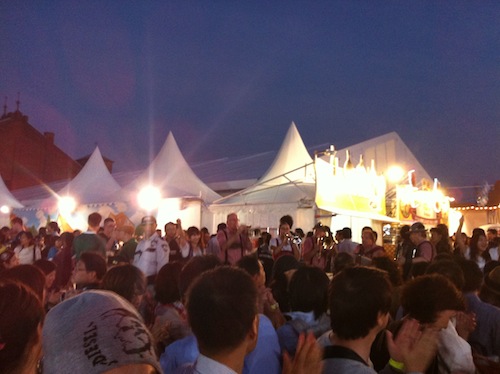
There were a couple moments the other day when I was reminded that Japan does things a little differently. It was about 7pm at the Yokohama Octoberfest, every seat was packed and people were clearly enjoying themselves when a couple of foreign guys stood atop their benches to greet the rest of the crowd. They promptly got a friendly response from all the other revelers but were just as quickly and politely told to sit down by security (a security I hadn’t even noticed until that point). They didn’t complain, they sat down with a smile and everyone carried on as normal.

That this only happened once in the few hours I was at the festival didn’t betray a lack of good times. On the contrary everyone was thoroughly enjoying themselves and when the German musicians came out to greet the tables outside the main tent they got a fantastic reception, glasses and arms swaying as we all cheered along.
So what was different about it all?

To me, I guess it simply felt more grown up.

I hesitate to use the phrase as to suggest that the Japanese are in someway more mature than other nations, to imply that kind of comparison between nations at all feels condescending.

The truth is that what I’m talking about isn’t maturity but a manifestation of culture.

Though people of a European or North American background make up less than 0.5% of the population in Japan the figure is marginally higher in Yokohama which prides itself on being an international city.

Nonetheless however, Yokohama is still overwhelmingly Japanese and as such so was yesterday’s event. Japanese culture, not an international mix was the dominant force in setting the atmosphere of the day and so I doubt 95% of the crowd would even consider for half a second, no matter how heartily they’d taken to the festivities or yards of Heineken they’d drunk (if the crowd wasn’t that international the choice of beer certainly was), clambering atop their bench and drawing all the attention of the other drinkers towards them.
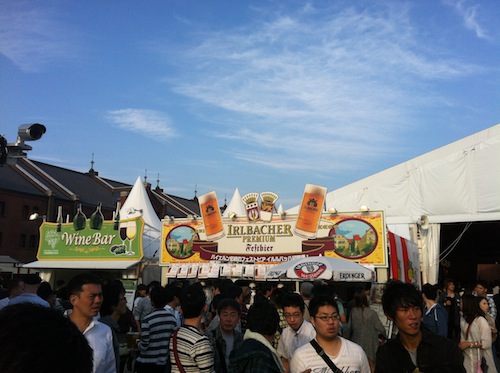
What makes this even stranger is that this kind of behaviour, from a British point of view at least, ought to be more pronounced at a Japanese Octoberfest. That Far East Asian people often have a lower alcohol tolerance than other ethnic groups is a fairly commonly held conception (I wouldn’t like to make too much of a claim as to its veracity, anecdotally at least it seems to hold true…ish) as such shouldn’t there be more not less drunken shenanigans? Hell, even based on the lower average height and weight of the Japanese this ought to hold true.

Yet, no.

Not at all.

Once again I’m inclined to believe that culture trumps genetics because as Kate Fox of the SIRC (Social Issues Research Centre) noted in her episode of Four Thought  on the BBC last October, alcohol by and large has little to do with how we act as a nation when knocking back the booze. Far more powerful are the myths and narratives that we build around it. The self fulfilling prophecy that imbibing inevitably leads to putting a traffic cone atop a bus stop. Or as she rather more academically describes it,

“The effects of alcohol on behaviour are determined by cultural rules and norms, not by the chemical actions of ethanol.”

The article further mentions that countries like the UK and US have something called an ambivalent drinking culture, in that we assume all manners of behaviour, usually negative, to be the by product of alcohol consumption.  However, in Integrated cultures e.g. many Mediterranean countries, alcohol is seen as morally neutral  therefore these kinds of negative behaviour aren’t associated with alcohol consumption per say.

So where does that leave Japan?

Well, certainly many things that might be considered to be a moral matter here such as sex and gambling, aren’t viewed in quite the same way as they are in countries with a different religious background. Certainly alcohol isn’t seen to be as much of a moral issue as a practical issue.

Take a look at the decline in Salaryman pocket money over the years or the tradition of handing over one’s pay cheque directly to one’s wife in Japan for example. Men drinking too much isn’t so much a moral problem, it’s a practical one. There are home loans, children’s educational costs and taxes to pay first and if there’s something left over then the husband might be able to spend it on a night at an Izakaya.

There’s one problem with my argument though.

Yes, culture appears to dictate what is acceptable behaviour while drinking, however, while national cultures are persuasive in this way (and the Japanese have the proverb, “the nail that sticks out gets hammered down” for a reason) sub-cultures are equally if not more persuasive at times. So as you read about the surprising maturity evident at an Octoberfest event of all places, there is most probably a drunk salarayman asleep across four seats of the train disproving my foolish notion.

Shoganai ne.

Or as we say in English, ‘it can’t be helped, can it?’

Ah well, let’s just stop worrying and enjoy it shall we?

Cheers!

Earthquake Drills for the Tall

I realized something the other day for the first time. My height, in this country at least, puts me in a greater amount of danger than some other people. I don’t mean the usual, ‘mind your head’ warnings as I go through doorways (though they have certainly nearly knocked me on my arse a couple of times) it’s actually related to earthquakes.

I recently began working for a very large school and so just the other day, conveniently as the thermometer was climbing to a crisp, thirty-five degrees, my school decided it was about time we had that earthquake and fire drill we’d initially planned to hold last term that unfortunately had to be cancelled; due to a typhoon.

My kanji still being a work in progress the other English teachers explained to me that there would be an announcement fifteen minutes into the lesson and at that point I’d have to make sure that all the kids dived under their desks in readiness for an imaginary earthquake. Also, that in order to set a good example I too should clamber under my desk.

Here’s where my problem occurred. I have a standing desk. Said standing desk has a small shelf beneath it, designed presumably for storing a binder or something and as such there are certain height restrictions.

The manufacturer will no doubt be happy to know that said binder will no doubt be safe in the event of an earthquake. It may be a touch blood splattered but it’ll in good nick nonetheless.

However, as I’ll be in no condition to apologise for the Jackson Pollack effect due to my untimely demise  I really ought to do so now.

Sorry.

P.S. I’ve signed the folder, so it should at least triple in value after I’m gone, right?

Fluently Worrying

In my daily life I think a lot about language. How to use the Japanese language correctly, my choice of vocabulary and grammar when addressing my students in English, my use of tone and expression, the physicality of my language, it all gets thrown together in a jumbled mess of simplified English and broken Japanese.

The thing is, this mess needs to convey an idea that doesn’t come naturally to most people and certainly not to Japanese teenagers.

The idea that in order to learn a language you have to not only be unafraid of making mistakes but care enough to want to fix those very same mistakes.

It’s a difficult balance.

One thing I don’t do is sugarcoat it. I don’t pretend that what they’re studying is easy, that it has a sense of logic that they ought to be able to grasp easily. Language doesn’t work like that and a language born of so many people and cultures as English is a hodgepodge.

More than that it’s a sadistic, cacophonous, beautiful, shambles of a language.

And I love it for it.

However, for teenagers this cluttered lingua franca is encountered in an environment where the wrong answer is to be feared because a wrong answer symbolizes more than, ‘I don’t know right now,’ it often feels like it means, like it displays to the entire room, ‘I will never know the right answer.’

I can remember that feeling well from High School French or Spanish classes where we were dragged through a textbook kicking and screaming, ticking boxes and attempting to build on linguistic steps when the foundations hadn’t fully dried yet.

If you take a quick ride on any train in Japan it would be abundantly clear that this kind of feeling continues to linger on long into adult life here. Dotted around every carriage are advertisements for an endless variety of English conversation schools promising to improve an obviously faltering and feeble grasp of the English language.

If I could change one thing about Japan it’d be these blasted adverts. I’d replace them with ones that say,

English is hard. It is not impossible. It takes at least three thousand hours of regular study for a native speaker of a non-European language to reach an advanced level. Please stop worrying and enjoy your day.

Better yet, what’s the Japanese for Keep Calm and Carry On?

Travel by Tweet: How to Throw Away Your Guidebook in Japan

I was in Shizuoka City looking to find a nice little bar I’d read about for a celebratory pint (I’d just got a new job), when once again I was reminded how little people know their own cities and towns.

Everyone I asked had little idea about where I was talking about. In fact, at one point I was stood almost beneath the sign of the bar in question, as usual unable to spot anything that isn’t directly under my nose.

Eventually I asked two gentlemen where I could find the bar; not a clue, never heard of it. We were ten feet away.

On my second lap around the block I did eventually spot it and rather embarrassedly walked up the stairs to find ‘Beer No Yokota.’ Fortunately it was more than worth getting a little lost for.

It’s understandable I suppose that people don’t always know their own towns so well. When it’s the place you call home it’s easy to get into a routine, to only dine and drink at the usual familiar places, to discover new places through the recommendations of friends, family and co-workers. In Japan, with the tendency for restaurants to be tucked away on the fourth floor of a non-descript tower block it’s easy to never know a place even exists.

Now this can be a problem for those of us who live in Japan and speak a little/a lot of Japanese. So how much more difficult must it be if you’re in Japan on holiday, what do you do if you’re trying to escape Tokyo, Kyoto, Osaka or any other tourist friendly location for a slice of real Japan?

Go with your guidebook?

Hardly.

With the Lonely Planet Japan guidebook devoting around one hundred pages each to the big three of Tokyo, Kyoto and Osaka it’s easy to understand why other areas get fewer pages assigned to them.

Even then it’s inevitable that otherwise great travel writers are going to miss some local gems when they haven’t got the time to search out every hidden corner of a town.

Indeed even if you’re local it can be pretty tough to get recommendations from Japanese people. Particularly if you’re a teacher out here, as many long-term foreign residents are, then your students will often be reticent to offer recommendations for fear that you won’t like the places they enjoy.

However, there’s another reason why it’s so hard to stray off the well-worn guidebook paths and in likelihood it’s the one you’re worrying about.

The language.

Leaving Tokyo and it’s English menus behind can be daunting for many travelers but even if you haven’t had time to master some few thousand Japanese kanji there’s no reason why you shouldn’t try to enjoy a bit of real Japan. Armed with a couple simple phrases and a little local knowledge there’s no end of places to discover outside of the big three.

So how to go about finding them?

Go local. Get specific.

Not literally.

Digitally.

I discovered Beer no Yokota via the gastronomic musing of one Shizuoka Gourmet

If you’re a craft beer fan like me then you won’t go wrong with the Japan Beer Times a bilingual go-to-guide for all you Hop Heads out there.

Fancy catching some footy while you’re out here? Then take a look at the fan blogs for a quality English resource. My local team, Shimizu S-Pulse is followed by the UK Ultras who offer the complete lowdown on everything you need to know to get to the games and sing along with the fans.

For those of you who’d prefer to spend your holidays in a more healthy fashion taking in all Japan’s beautiful outdoors has to offer then head on to Outdoor Japan.

However, if you want to track down somewhere with a limited web presence, a pretty common thing in Japan, then look no further than Twitter. Once you’ve found one person or company who shares some of your interests then Twitter handily starts recommending more of them to you. On top of that it’s one of the few forms of publicly accessible social media that Japan has truly embraced.

It’s also an easy way to discover real life connections between places as most independent places know the other people running shops and restaurants in their town and follow them on Twitter.

So there it is. A little prep, a little wi-fi and possibly a lot of google translating later you can be sat in a little antique café, eating local ice-cream or supping the local brew.

And when you do, don’t forget to blog or tweet about it so the rest of us can enjoy it too.


How to Survive the Japanese Summer

The Japanese are particularly proud of their four seasons. Blissfully unaware that many a nation also enjoys four varieties of weather, they nonetheless do have a great deal to be pleased with when it comes to the climate.

On one end of the scale I’ve been fortunate enough to live in Nagano Prefecture in freezing cold December when though my toes were either freezing off or close to melting under my kotatsu, I was able to enjoy the beauty of an endless range of snow capped mountains in every direction I cared to look.

Similarly my luck in landing just at the top of the Izu Peninsula, in sight of Mt. Fuji, a short train ride from the beautiful coastline and wonderful sunshine through most of the year is something… I’m not currently enjoying all that much.

You see there’s one problem with being an Englishman in Japan. We are by our very nature, atsugari or sensitive to the heat.

Now we’ve been having beautiful thirty one degree days around here of late, which would be fine if it weren’t for the horribly, stifling humidity. The sad reality of this is that I am too hairy, too painfully, awkwardly, sweatily British for such climes. I feel my brow gush salty water down my face from the second I step out the door in the morning and doubly so when I finally enter a beautifully air conditioned building for work.

It ought to be a relief yet the reality is that such a sharp change in temperature, while initially refreshing merely leads all the humidity you’ve somehow gathered up and dragged with your heavy-laden legs through the door to condense in seconds thus drowning you from within your own clothes.

So how do the Japanese survive this?

Well there’s cool biz which is essentially the sale of clothes that happen to cope far better with humidity and heat and the absence of long sleeves and ties for men.

There’s the air conditioners turned up to full blast despite last year’s and this year’s efforts at power saving or setsuden.

I personally make use of a frozen pillow while others opt for a strip of cool, blue fabric stuck to the back of their neck or to their forehead.

However, if you really want to understand how the Japanese get through such muggy, draining heat waves you’ve just got to look at how people spend their evenings in the summer months.

Summer festivals, fireworks, cold beer, BBQ meat on a stick and shaved ice in a cup topped with bright, fruity, sugary, sauce aka kakigori.

Much like I couldn’t make it through the misery of England’s winter months without Christmas and New year’s to brighten my horizon I couldn’t imagine getting through a long summer here in Shizuoka without the relief these festivals bring.

There really is nothing like seeing a previously sleepy town erupt into life as every family from miles around comes to eat, drink, carry Mikoshi (portable shrine), bash away at the Taiko drums and dance in the street.

So if like me you’re melting in this summer heat, do yourself a favour, slip into a yukata don some geta and crack open a cold one while gazing at a sky filled with more fireworks than Guy Fawkes has ever seen.

And be thankful, that while Christmas comes but once a year, matsuri (summer festivals) are every weekend.

The Japanese and English Cuisine

All this nonsense talk of micro-aggressions and flyjins that hovers about the Internet is nothing but a shallow distraction, a bit of rubbish that shifts attention from the truly awful, the god honest hatred for one thing that runs through Japanese society.

I encounter the disdain, the condescending smile, the knowing looks and pitying glances often in my working life. The respect I’m usually afforded as a teacher despite my few years is replaced by a little chuckle and my immediate relegation from senior or equal figure to foolish foreigner, ignorant visitor to these lands.

I try to laugh it off. I dismiss it as ignorance and not to be taken seriously. In my line of work you really ought to believe that you can educate individuals away from such unworldly views.

Yet, it’s no use. This is a nation reared on a televisual journey through the hinterlands of travel and haute cuisine. Every evening, nay every moment of the day that the TV illuminates the corner of the apartment it acts like some neon kami (Japanese for god), a tiny bacchanalian Buddha and pretentious prophet all rolled into one as it dispenses its unquestionable wisdom to the masses.

And what does it teach this culinary cult, these devotees of sofa-based exploration?

That not only is Japan the home of the world’s greatest cuisine but that it finds its perfect antithesis in where I call home; England.

Perhaps the humble fish and chips, or fishuandochipusu as it’s known here, is an exception to this rule such is its place on so many bar menus but the rest of my home nations culinary output might as well be poured down the drain the moment we’ve finished over cooking it.

My tongue now having thoroughly bore its way through my cheek I really ought to discuss where this seemingly globally accepted view actually comes from.

While the TV may be the purveyor of the accepted wisdom, it undoubtedly is entrenched enough now that very little could change Japanese minds.  It’s out there, as true to the Japanese as the strike happy, surrender quickly nature of the French is to the English. We don’t always believe it is true, but we certainly enjoy acting like it is.

However, in my opinion, away from Japanese TV there is a simpler geographical reason for this perspective.

Train stations.

Train stations in Japan are the epicenter. They are at the heart of the city. Everything emanates from that point and the better a thing is, the more likely it is to be on the doorstep of the station.

In Kyoto station there is an entire floor devoted to the art of Ramen. Beneath almost every major city station in Japan there seems to be a food court. Walk out of any train station in Japan (except for seriously countryside places) and you will almost certainly discover a decent number of rather good restaurants right in front of you.

Compare that to the train station in London I used to live nearby, Paddington and the contrasts are pretty stark. Directly opposite the main entrance at the crossroads by the Hilton Hotel sits the following; a Burger King, a KFC, a McDonalds, a Garfunkel’s and an Aberdeen Steak House.

Now, there’s absolutely nothing wrong with fast food, it does exactly what it says on the tin, if you can’t hold back from the desire to stuff your face with it well that’s your issue, but fine dining it is not. Two minutes past this cavalcade of calorific confidence men sit yet another crappy steak restaurant and two ‘traditional’ English pubs. These pubs however are no fair reflection of British or English cuisine anymore than Kappa Sushi ought to be considered Kaiseki Ryori in Japan (as goodandbadjapan recently noted on his blog – always a wonderful read).

Yet, if you venture a further two minutes down that very same street you’ll come across The Victoria Pub. It’s a beautiful place, has genuinely good food and an ambiance that Hub Pub’s across Tokyo would kill to replicate. Around the corner from that is the Mitre, yet another fine example of a good English Pub. That both happened to be my locals for a short time in my life is something I will always be grateful for.

In reality if anything in England might find its antithesis in Japan it certainly isn’t food, it’s urban planning.

Unfortunately the simple hint, walk five minutes more, isn’t in any guidobuku I’ve ever seen. However, I’ve been correcting this one globetrotting student at a time and bit by bit I think it’s starting to work.

All this is really just my way of saying, if you work in either of the lovely pubs I just mentioned and have been very politely, if quite forcefully cajoled into posing for photographs with some very nice Japanese ladies thoroughly enjoying their holidays, then thank you. You have by plate and by pint managed what I never could; you got them to disagree with the TV.

8DZW4Z69K3P4